Showing posts with label Lutheran Theological Institute. Show all posts

Tuesday, 27 June 2017

Ordination in ELCSA-SED 25 June 2017

What a joyful event. The South Eastern Diocese of the Evangelical Lutheran Church in Southern Africa got 13 new pastors on Sunday 25 June. I was privileged to be part of the service, which took place at the Diocesan centre at Umphumulo. This might be the last ordination service that Bishop P P Buthelezi leads. He will retire later this year. On this occasion he was surrounded by two other bishops namely Bishop Emeritus S P Zulu (one of his predecessors)  and Bishop Emeritus Dr M Biyela, former bishop of the Eastern Diocese.

Five of the candidates I have taught – either at the Lutheran Theological Institute (LTI) or at the School of Religion, Philosophy and Classics (SRPC) at the University of KwaZulu-Natal (UKZN). The main reason for my presence was however the ordination of Rev. Selom Klu. The first time I met him was in Kalmar in the South of Sweden. I think it was in 2010. He lived in Blomstermåla and was very active in Ålem Parish, where my wife worked as Parish Educator.

We moved to Pietermaritzburg in South Africa 2013 and in 2014 Selom also moved there. He lived at the LTI and continued his theological studies at UKZN. He was my student in homiletics and liturgy. When we moved back to Sweden in 2015 Selom remained in South Africa and last year he was accepted as a candidate for ordination into priesthood.

Selom is originally from West Africa and is now a full pastor in the Evangelical Lutheran Church in Southern Africa after a number of years in Sweden. The common feature here is of course the Lutheran Church. Selom was born into the Lutheran Church in Togo, became active in the Lutheran Church in Sweden and now in Southern Africa. With this blog post I want to share some highlights of the ordination service.

The first youtube clip is part of the Nicene Creed, which the candidates confess together.


Thereafter Bishop P P Buthelezi asks the candidates a few questions and they all answer yes.


Central in any ordination service is when the candidate gets the stole laid on her or his shoulders. (In Church of Sweden the bishop always literally does that part.) On the other hand priests in Church of Sweden do not get a bible, an altar book, a chalice and a paten. (One has to mention that the chalice and paten is just there as symbols. The rest is given to the candidate. This means that every candidate keeps chasubles in every liturgical colour. In Church of Sweden the chasuble belongs to the Parish and is kept in the church.)


The laying of hands is also a central part of the liturgy. In this case it is the bishops and the deans that lay hands on each candidate.


Each candidate is introduced to the congregation. It is the deputy bishop, Dean N Myaka, who introduces them and he describes Selom as a missionary with links to Church of Sweden.


Here follows some photos from the ordination service.


Rev. Selom Klu


Bishop Emeritus M Biyela, Bishop P P Buthelezi, Bishop Emeritus S P Zulu.


Directly after the ordination all the newly ordained walk in a procession to meet their congregants.


All the 13 newly ordained. Eight of them are self supporting ministers and the other five are full pastors. Among them are some of my students. Second from the left is Selom Klu. Sixth from the left Ntuthuko Nkosi. Next to him Nokukhanya Mngoma and thereafter Njabulo Madonsela. The tall pastor fourth from the right was also my student: Msizi Mkhathini. I was very happy to be there and 
participate in their ordination.

Sunday, 25 October 2015

En innehållsrik helg

I fredags åkte Amanda, en av fyra studerande från Svenska kyrkans utbildningsinstitut, till stiftfest i Vryheid. Hon åkte tillsammans med de tre systrarna på den lutherska kommuniteten Kenosis, under ledning av syster Happiness. I morse anslöt Johanna. Hon åkte tidigt i morse med en grupp lutheraner som bara skulle vara med på söndagens stora gudstjänst. En av studenterna på LTI, Sicelo, är med som guide. Samtidigt har Maria och Ingrid varit i Durban tillsammans med en annan av studenterna på LTI, Jeritta. Jag vet att de gått i kyrkan idag och tror att Jeritta också tagit med dem till stranden.

På stiftsfesten har Amanda, som ju ska prästvigas för Skara stift, träffat hela sitt kommande tjänstgöringsstifts vänstift: Sydöstra stiftet i den Evangeliska Lutherska kyrkan i södra Afrika (ELCSA). (Ja, även Johanna har ju träffat dem, förstås.)

Själv firade jag gudstjänst i Eastwood, vår gamla församling. Där mötte jag de två ungdomar som varit med på två resor tillsamman med Skara stift: Walking to Emmaus. Nondumiso och Nompilo. De hade så gärna varit med på stifsfesten, där även Ashraf från Palestina fanns med, som de nog också träffat, tror jag.

Den världsvida kyrkan utgör en viktig motvikt till alla andra globala nätverk. Vapenindustrin, porrbranshen, traffickingligor, terorrister och alla knarkhandlare. För att nu bara nämna vissa. Hela den råa kapitalismens international är förmodligen värre. Varje gång kristna möts över olika gränser händer något viktigt. En motvikt.

Idag firar den lutherska kyrkan i södra Afrika Reformationsdagen. Predikan handlade delvis om Martin Luther. Efter predikan hölls ett 'motivational speach' riktat till ungdomarna. Särskilt dem som nu slutar gymnasiet. Det handlade om vikten av att ha en dröm och att våga tro på möjligheten att nå sin dröm. Samt att börja leva sin dröm redan nu. Men det handlade också om att ett misslyckande inte behöver vara slutet. Den som höll talet, en student från LTI, berättade att hans sista år på gymnasiet tagit 5 år, innan han klarat alla kurser.

Sundayschool singing.
Efter talet fick söndagsskolan komma fram och sjunga en sång som handlade om att Gud för oss upp över bergen. Fint!

Kanske mest rörande var när en gammal kvinna i rullstol uppmärksammades. Det var Nompilos mormor och hon kommer från en gammal svensk missionsstation, Apelsbosch. Alla var så glada att just hon var där. En av de närvarande prästerna, Lilana, fick gå fram och be särskilt för henne. Tillsammans bad vi också för alla som ska ta studenten i vår (november).

Ja, det var en innehållsrik gudstjänst. Efter en innehållsrik helg. I fredags hade vi lektioner med både rektorn på LTI, Matthews Shabele och några av studenterna. Jag träffade en professor på universitetet, som lovade vara bihandledare till min masterstudent. Härligt! På kvällen var vi bjudna på braai (grillkväll) hemma hos Rico och Mari (kollegor på universitetet) där vi fick träffa andra studenter, som Rico och Mari känner. Bland annat från Nigeria , Zambia och Malawi.

Lördagseftermiddagen ägnade jag i France (som inte är Frankrike, utan ett s k township) där Rebecka och Michael bor med sin familj. Där var även Kajsa med två av sina barn.

För en stund sedan besökte jag vårt gamla hus och träffade alla studenter som bor där. Från Zimbabwe, Swaziland och Sydafrika.

En fullmatad helg som ändå innehållit mycket vila. Jag undrar hur de fyra studernade från Sverige haft det? Spännande!

Tuesday, 20 October 2015

Praktik i den världsvida kyrkan

Egentligen kallas det ju Verksamhetsförlagd utbildning (VFU) men det kan gå lika bra med praktik. Ett gammalt hederligt ord. Till skillnad från teori. Det passar också mig, som ju undervisade i praktisk teologi under mina senaste två och ett halvt år i Sydafrika.

Hittills har praktiken för fyra studerande från Svenska kyrkan inneburit lite av varje. Allt från första söndagens gudstjänst på det lutherska prästseminariet, lektion på måndagen kring nattvarden med sistaårsstudenter, tisdagens teologiska café på universitetet om söndagsskolematerial och socialisering vad gäller könsidentitet och sexualitet, onsdagens studiebesök på ett forskningsprojekt kring HIV, torsdagens presentation av hur kyrkornas världsråd arbetar i Palestina/Israel och fredagens lektion i 'Christian Education'.

The Sunday School children always have their own basket (or in this case plastic
bucket) for their collection.
Sedan blev det utflykt till församlingar. Inte med studenter, som var avsikten men väl omhändertagna i olika hem. Lördagen kom att innebära det som lördagar i Sydafrika ofta innebär. Begravningar. En upplevelse i sig.

På söndagen gudstjänster i olika kyrkor och nya upplevelser.

Dessemellan samtal, måltider och mycket annat där kontakter knyts med studenter och kristna trossyskon i Sydafrika.

Det blev en hel första vecka utan ledig dag men å andra sidan var ingen dag egentligen fullmatad. Mycket ställtid. Aldrig riktigt upptagen men heller aldrig riktigt ledig. Också det en erfarenhet av livet för en t ex en präst i kyrkan i södra Afrika.

Inte desto mindre blev det välkommet med en ledig måndag.

Pens Pelesino Pens is preaching. In front of him two of
the examiners.
Idag tisdag har vi varit med sistaårstudenterna på en av deras examinerande gudstjänster. Några blev utvalda att predika och agera. Stämningen var lite nervös. Men det kändes som att alla visste vad de skulle göra – i stort sett. Jag känner igen mig från liknande examaminationer på Utbildningsinstitutet. Med den skillnaden att denna examinerande gudstjänst var offentlig och kyrkan välfylld.

Därefter är det nu dags för ännu ett teologiskt café. Denna gång är det gruppen från Sverige som ska presentera sig och de kyrliga utbildningarna i Svenska kyrkan. Dels hur Svenskas kyrkan utbildningsinstitut i allmänhet fungerar. Dels hur arbetssättet 'Writing as a way of thinking' går till. Jag återkommer med rapport om hur det gick.

Morgondagen kommer gruppen att besöka en luthersk kommunitet, där de tre systrarna (varav en är prästvigd) driver både förskola och barnhemsverksamhet.

Fortfarande mycket ställtid men åtminstone en aktivitet varje dag.

Praktik!


Wednesday, 14 October 2015

Internship in South Africa

Right now I am back in South Africa. Back in Pietermaritzburg. Back at the Lutheran Theological Institute and the School of Religion, Philosophy and Classics at the University of KwaZulu-Natal.

On Saturday I arrived together with four students from the Church of Sweden Institute for Pastoral Education. They are here on a kind of internship. They are all doing their final year. One will become a Parish Educator, one is training to become a Deacon and two will be Pastors.


Today we joined a group from the University on a field visit to Vulindlela. It is an area west of Pietermaritzburg. An organisation called CAPRISA has a research site there. The acronym CAPRISA means: Centre for the Aids Programme of Research in South Africa. It is supported by UNAIDS and really an impressing initiative. The trip was organised by CHART. Collaborative for HIV and AIDS, Religion and Theology.


The organisation carries out pharmaceutical trials, partner with a number of clinics, run projects for youth, offer counselling and testing etc. They also cooperate with the community and look at a number of reasons why the HIV infection rate is exceptionally high in this area. About 40% of the population are infected with HIV. And new people get affected all the time. Not only here, but in the whole world! Every day there are 6 000 new infections in the world. 4 000 of those are in sub-Saharan Africa. This according to UNAIDS. The HIV pandemic is not over.

What I found both interesting and disappointing was the information that many young women in Vulindlela have inflammation in their genitalia. The reason is the idea that men like their vaginas to be dry. So with different herbs and other methods they try to achieve this and this of course damage their bodies. With inflammation it is much easier for the virus to get into the woman’s system and she becomes infected.

We were also told that many young women opt for anal sex. There are a number of reasons. One is that they don’t fall pregnant, which is true. The other that they keep their virginity. The third reason is of course false – they believe that anal sex is safer from a HIV perspective. It is actually the opposite.

So, the spread has to do with gender roles, lack of information and a number of other things.

One of the staff members we met used a metaphor called “the Cabinet”. Young women in the rural areas get infected by different “cabinet ministers”. 1) The Minister of Transport, is the man that takes her to school when it is raining or when the road is too long. In exchange of … 2) The Minister of Health buys food, soap, clothes and other necessities for her. In exchange of … 3) The Minister of Education can be either a teacher or a man who pays her school fees. In exchange of …

I had a nice conversation with one of the staff members. Ulenta. She gives support to the clinics in the area. There are about 90 000 people living in Vulindlela, so there are a number of clinics. They are often understaffed but with proper routines and systems in place they can do their work much better.

CAPRISA is doing a great job. To save lives. To empower people to live better lives.


Together with Ulenta.

Saturday, 10 October 2015

VFU 2015

Amanda, Johanna, Ingrid, Maria och jag är välbehållna framme i Sydafrika.
Efter många års visionärt tänkande, en del motgångar och mycket planering händer det. Verksamhetsförlagd utbildning. Förr i tiden kallades det praktik. Fyra studerande från Svenska kyrkans utbildningsinstitut har precis landat i Sydafrika. Eftersom jag var utsänd av Svenska kyrkan till just Sydafrika när detta bestämdes och sedan dess flyttat tillbaka till Sverige, fick jag följa med.

Samtidigt har sex studerande åkt till Makumira i Tanzania. Alltså är det sammanlagt 10 studerande, som får göra sin VFU i två av våra partnerkyrkor på södra halvklotet. Underbart. Slår det bäl ut skulle det kunna bli ett utbyte på sikt.

Ungefär lika många är också ute i utlandskyrkan. De är kvar i Europa. En viktig erfareenhet även det.

Resten av alla blivande församlingspedagoger, diakoner och präster finns i församlingar i Sverige. Kyrkomusikerna, som bara går en termin, har ingen VFU.

Vår grupp, som alltså ska vara i Pietermaritzburg och bo på the Lutheran Theological Institute (LTI) består av Johanna Sjöström (blivande församlingspedagog), Maria Bjerklow Dean (blivande diakon) samt Amanda Nyberg och Ingrid Hammarberg (blivande präster). Och jag, förstås!

Just nu är vi på O R Tambo international airport i Johannesburg. När vi kommer till Pietermaritzburg senare idag blir vi mötta på flygplatsen och kommer att få ägna resten av dagen åt att vila.

Imorgon, söndag, tas vi emot i högmässan, som börjar 08.00 och varar ungefär två timmar. Sedan ska vi sitta ner och planera de tre veckorna. Det är spännande. Vi har ett avtal med den lokala kyrkan och har haft ett planeringsmöten under första halvan av året. Ändå är lång ifrån alla pusselbitar på plats. Vilket är i sin ordning. Jag är trygg och övertygad att detta blir tre oerhört viktiga veckor för gruppen och genom dem även för Svenska kyrkan.

Det är nu det händer!


Monday, 22 June 2015

Bittersweet

It is sad! At the same time it is nice. Bittersweet! I am talking about the time to say goodbye.

Two weeks ago I preached at the Lutheran Theological Institute. After the service there was a short program with students and colleagues saying nice things. And so a present. After that vote of thanks. Many hugs. Some tears.

One and a half week ago the School of Religion, Philosophy and Classics arranged tea for the staff. My wife and I had baked cakes. A nice speech from the Dean, some singing and a chance for me to say a few words about the time at the School.

Yesterday I preached in the Lutheran Church at Eastwood. It has not been part of my job description to lead services there from time to time. The same with my wife, who has made other contributions to the life of the church.

The way the congregation thanked us was overwhelming. This has been our spiritual home during 2½ years. The Sunday School had prepared a drama, the youth sang. The Women’s league did that as well. After some persuasion from the oldest member, Mrs Dolphin, the fathers also delivered an item.

My colleague, Rev. Kholiwe Biyela, spoke with warmth. Yes, it was in deed touching.

We were also given very nice outfits, to wear in Sweden. These are typical modern Zulu outfits.

We really appreciate all the farewells – each one in their own right!

We often say that South Africa is our second home country. This means that we will be back!


Some dancing was necessary!


Monday, 15 June 2015

Axel-Ivar ‘Dabulamanzi’ Berglund

Today my friend and mentor - in a sense one of my spiritual fathers - Axel-Ivar Berglund was buried. The funeral service, with Eucharist, was held in the Cathedral of Uppsala. Here in Pietermaritzburg we held a memorial service. It started at 11 am and ended 1.30 pm – exactly when the funeral in Uppsala began.

The chapel at the Lutheran Theological Institute was not full but many people came. Former students and colleagues of Axel-Ivar as well as the students of the institute were there. A few persons were given a chance to say a few words, among them two retired Lutheran pastors: Rev. Nxele and Rev. Naika. Also prof Draper from UKZN, one of my colleagues, spoke.

The service was led by Bishop Biyela. The local dean, Myaka, and another pastor also took part in the liturgy. I chanted the Swedish funeral prayer (begravningsmässan). So, the service was held in English, isiZulu and Swedish.

So many good words were said about the life and contribution of Axel-Ivar. A priest, an ecumenist, an activist, an academic were some of the perspectives. His zulu name was used by some: Dabulamanzi, which means 'the one who crosses waters', if I am not mistaken. Rev. Naika, who is from the Indian community, gave him the title: My Guru.

The strongest impression today the oldest, present person made on me. Rev. Nxele came with his wife. He was driving himself. 91 years old. He was ordained in 1958 by the bishop of Stockholm, Helge Ljungberg, who had flown down to South Africa because the local bishop had died. After ordaining Rev. Nxele, bishop Ljungberg consecrated a new bishop in what was then the South Eastern Region of the Lutheran Church. His name was Helge Fosseus.

When I was writing this blog post I felt I needed to check the spelling of Rev Nxele’s surname. So I googled. And I found his name in an article. In a footnote. The article’s title is:
Black critics of Lutheran Mission in Zululand and Natal in the 1950s, with particular emphasis on socio-political issues. By: Odd Magne Bakke
The foot note reads:

Both the retired Zulu pastor, R. E. Nxele and the retired missionary A.I. Berglund
emphasized this fact in interviews with the author respectively in Durban (November 2008) and in Uppsala (October 2010).
Isn’t that strange. There they are. In an academic article about the critique of western mission in South Africa.

Today they were united in another way. Far apart in so many respects but in the sacramental reality close.

Of course it would have been fantastic to be part of the funeral Service in Uppsala, but in the universal church it does not really matter. I know that a colleague from Pietermaritzburg, Rev. Bongani Zulu, was present in Uppsala, in the cathedral where his great, great uncle, Joseph Zulu was ordained as the first African priest of the Church of Sweden in 1901.

The relation between the Evangelical Lutheran Church in Southern Africa and the Church of Sweden is old and there are so many personal links. I feel privileged to be part of this relation. I am thankful for the world wide – in the true sense of the word – Catholic Church.

Today this church, which crosses over borders, celebrated the life of a son of the soil: Axel-Ivar ‘Dabulamanzi’ Berglund.

Hamba kahle, Baba! Go in peace, Father!


Saturday, 21 March 2015

Celebrate, remember, fight back

Yesterday we took part in
CANSA Relay For Life
It was a 12 hour activity in Cascades, in Pietermaritzburg. We stayed three hours. With this blog post I want to show my respect to students and staff from the Lutheran Theological Institute, who stayed the whole night. Well done!

While were still present a program was held with some touching parts as well as a guest speaker. Most touching, for me, was when a group of survivors walked a lap together. (We were all gathered around a short track.) This was the celebrating part. The guest speaker, also a survivor, was also part of celebration.

The empty space ...
Another part was remembering those who have died. An empty table was placed in the middle of everything, symbolising all those spaces that are now empty, because someone passed on. But even in this part of the event, it was pointed out that there is also hope, symbolised by a candle on the table.

I guess the rest of the night was part of fight back. The teams had promised to walk right through the night in groups …
… because cancer neither slumbers nor sleeps.
This was a great community event. Where fund raising was one part and awareness-raising another.

The track was easy to see. On both sides the organizers had put paper bags with
battery lights. Many of the bags had pictures of lost ones. Other bags had names
of survivors or people still fighting against cancer in their own bodies.

Wednesday, 4 March 2015

About Lutheran Education and a mirror

Behind the table the panel sits, chaired by a Lutheran bishop from Namibia.
On this side of the table the academic staff of the LTI sit.
Today I attended the final session of a three days evaluation process at the Lutheran Theological Institute, in Pietermaritzburg. I contribute with some teaching there and was happy to be invited into this process.

The process started long ago and an internal evaluation has been carried out at the LTI. The management, the Council and the SALTTT (Southern African Lutheran Theological Training Trust) wanted this external evaluation in the first place and as far as I can understand the panel was well equipped for the task.

Today they delivered an executive preliminary report. The panel introduced it in a professional way, saying that this was not a forensic investigation but a report that should help the institution to improve. Already at that stage I could foresee that the critique was going to be substantial.

The report was divided into affirmations, commendations and concerns. I will not go in and reveal details, as I don’t think this is the correct forum. I just want to point to some areas where the panel had concerns. These areas are well known and so they also came up this time.

The history of the Lutheran Theological Institute is explained like this on the website:
The Lutheran Theological Institute was constituted by consolidating the Umphumulo Lutheran Theological Seminary (LTS) and the Lutheran House of Studies in Pietermaritzburg (Luthos) in January 2003.
Luthos had been there since maybe 30 years, run by the Lutheran Churches with German origin, called the United Evangelical Lutheran Church in Southern Africa (UELCSA). The Umphumulo Lutheran Theological Seminary (LTS) was run by the black church, the Evangelical Lutheran Church in Southern Africa (ELCSA). When the two institutions merged, the objective was to promote Lutheran Unity. This is still a concern. In my own understanding the process is too slow. An overarching vision in many South African contexts is to work towards transformation. I would like this to happen also in the Lutheran family of churches.

Another major issue is that the LTI lacks its own accreditation. Students get registered at the Theological Education by Extension College (TEEC) which is a correspondence institute. Staff and management at the LTI are working towards getting own accreditation as a tertiary educational institution. This process is also slow. Much hope is projected to accreditation as a quick fix. Which I guess will not be the case. But I do agree with other staff members that the TEEC arrangement does not work at present. Instead of being lecturers we as academic staff become tutors. My reading is that the teachers seek to get their own accreditation, so that they can build own curricula and teach Lutheran theology in a way that will allow them to teach with passion. Now academic staff has to abide with TEEC material. It is never good to just repeat what others have produced.

However, I am very happy that the evaluation took place and I now hope and pray that the findings will be shared amongst all the relevant stake holders and also that the institution will be transformed in this process.

The principal concluded by saying that the panel has acted as a mirror. When you see yourself in the mirror, he said, and find out that something is wrong, then you correct it.

Sunday, 21 September 2014

Marketocracy

Today it was baptism. Bishop Biyela
baptised one of his grand nieces, here
with the baptismal candle!
Bishop Musawenkosi Dalindlela Biyela preached at the Lutheran Theological Institute (LTI) today. It was a powerful sermon. On Jesus’ parable about the labourers in the vineyard! (Matthew 20:1-16) When the landowner comes to the marketplace and finds people standing idle, he says:
You also go into the vineyard ...
This became the theme of the sermon. What the bishop focused on was the grace that the owner of the vineyard showed to those that only had worked one hour. They got the same wage as those who had worked a full day. The grace is not only for some. It is for everyone:
You also!
But, isn’t it unjust? In a way, yes! I think the bishop agreed to this, when he said that the grace is disgusting!!

I have heard sermons about ’amazing grace’ but never about ’disgusting grace’. Of course he is right. Any labour union should be provoked by such an employer.

In the first scripture reading, from the Hebrew Scriptures, we heard of Jonah, who becomes furious when God was concerned about the people (and animals, too) of Nineveh! Jonah wanted God to punish the city. God refused!

We understood, of course, that the bishop preached about our relationship with God. And that none of us deserve God’s grace. But the bishop didn’t stop there. He went further and quite clearly he wanted to apply the text on our present situation in society. He spoke about the difference between the marketplace and the vineyard. How much better it is to be sent by God to carry out good work in the vineyard, than to stand idle in the marketplace. At one stage he said:
Maybe I am inventing a new English word.
Beautiful rhetoric! Of course everyone is listening for the rest.
We don’t live in a democracy. We live in a marketocracy!
This is in line with much of the material we study at the university in our module on Ecumenical Perspectives. The ecumenical movement today is outspoken about the role that the market is playing in the world. For example the WCC document
Together Towards Life
which I have mentioned earlier. It says in paragraph 108:
We affirm that the economy of God is based on values of love and justice for all and that transformative mission resists idolatry in the free-market economy.
This means, that God’s grace becomes something more than just a spiritual reality. It is a holistic concept. I like that!

Thursday, 4 September 2014

Val och stökigheter

Jag tänker inte på det svenska supervalåret. Även här i Sydafrika sker val. Det jag talar handlar om kårpolitik. Både på universitetet och på det lutherska prästseminariet (LTI) väljs Student Representative Councils (SRC).

På LTI blev jag ombedd att vara valförättare, tillsammans med bibliotekarien. Just nu är institutet i gungning av olika skäl och förtroendet mellan lärare och studenter har rubbats. Då blev lösningen att be en av bibliotekarierna och mig. Det är spännande. Vid två tillfällen har nomineringar skett och imorgon, fredag kl 14, ska jag hålla i själva förhandlingarna.

Oroligare är det på universitetet. Idag ställdes ett sammanträde in, p g a oroligheter. Eftersom vårt internet varit ytterst slött denna veckan och vi haft tekniker på besök, för att se var felet sitter, såg jag inte mejlet som kom kl 12.41 (inför ett sammanträde som skulle börja kl 14!):
Dear Colleagues,Given the student unrest currently underway, Prof Smit has advised that this meeting be postponed to next week.Cathy will confirm the date.We apologise for any inconvenience this may cause.RegardsCalvin
Jo, det skapar en hel del ”inconvenience”. En av de studenter jag handleder, skulle fått sitt ”research proposal” behandlat. Nu förskjuts sammanträdet till nästa vecka, men då var redan ett annat, också viktigt, sammanträde inplanerat. Som får skjutas till veckan därpå. Suck!

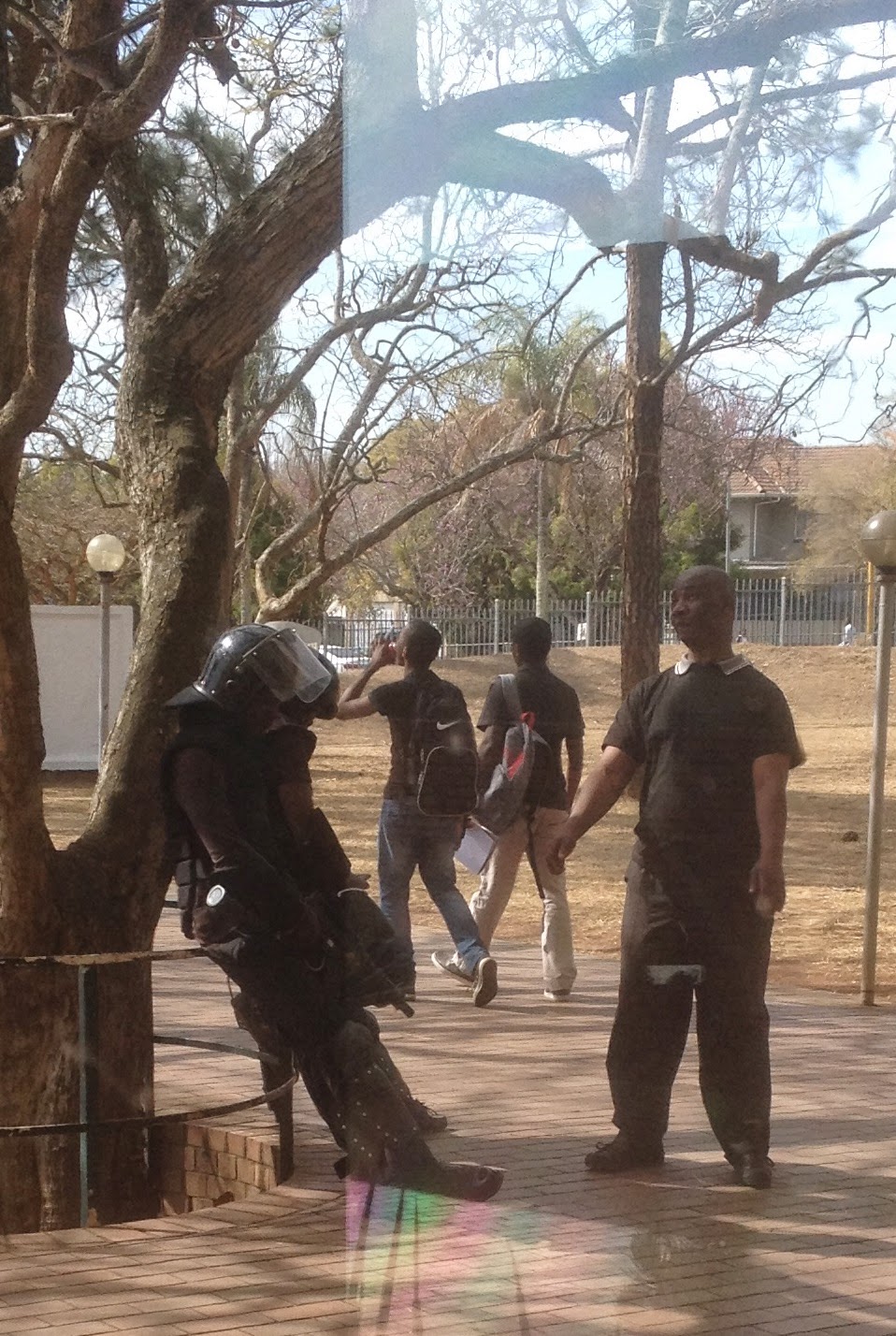
Jag ville inte gå så nära utan tog kort
på de beväpnade vakterna genom
ett fönster.
Jag hade alltså inte sett mejlet, när jag glad i hågen gick upp till campus. Utanför entrén stod två kraftigt beväpnade vakter. Jag försökte fråga dem vad som stod på men de var inte direkt pratsamma. Av mina kollegor fick jag sedan veta att det varit en viss turbulens på morgonen. Men jag bedömer inte att det var någon egentlig fara. Vi kunde säkert ha haft sammanträdet. De värsta oroligheterna skedde i Durban, på Westville, en annan campus. Där brändes en del bildäck och någon av demonstranterna hade visst varit beväpnad, enligt vad jag kunde se på TV-nyheterna. News 24 berättar också att en polis skadades av en sten, som kastades.

Bakom studenternas oro ligger, vad jag förstår inte alls i första hand det stundande SRC-valet, utan framför allt farhågor att avgifterna inför 2015 ska höjas. Liknande oroligheter brukar det vara varje år. Nu verkar det dock vara så att en del av demonstranterna inte ens är stundenter.

Från universitetet kom dock följande allvarliga meddelande kl 12.53:
Dear Staff and Students,The University's campuses of Westville, Howard, Edgewood and Pietermaritzburg experienced serious violent protests this morning. The Westville campus in particular was not accessible to University staff as well as students who reside outside campus.The Executive Management Committee deliberated on the situation this morning and took a decision to suspend the academic programme on all campuses for Thursday and Friday this week. The academic programme will resume on Monday, 08 September.
Nu skulle jag ändå inte undervisa dessa två dagar, så för mig innebär inte detta så mycket. Självklart är jag också försiktig men den information jag har är att det inte är någon fara för oss i Pietermaritzburg.

Men jag hoppas att vårt internet piggar på sig. (Det gör det i och för sig på kvällarna, det är därför jag kan blogga just nu). Men när vi idag hade haft en tekniker på besök i två timmar, såg resultatet ut såhär:

För den som inte är så bevandad i detta med datorer och internet
kan jag berätta att en uppladdningshastighet på 0.02 Mb/sekund
inte är särskilt snabbt. Snarar kan vi säga att det står still.


Monday, 26 May 2014

Kulturkrock eller inte? Det är frågan!

För någon månad sedan bestämdes datum för ett högre seminarium inom vår disciplin: Praktisk teologi. Ansvarig skickade ut ett ambitiöst program. Detaljerat! Hålltider under dagen och en redogörelse för i vilken ordning studenterna skulle presentera sina arbeten. I ett senare mejl lovade också min kollega återkomma med angivelse av plats för seminariet. Eftersom det var frågan om ett heldagsseminarium skulle det kanske äga rum på ett konferenscenter. Så att mat kunde serveras. Om det fanns pengar i budgeten.

Nåväl, kollegan åkte till ett grannland och återkom i fredags. Under helgen har jag väntat på information om måndagens seminarium. Jag har mejlat och skickat sms. Även pratat med de två andra lärarna inom praktiskt teologi. Tystnad!

I morse åt jag en tallrik fil innan hustrun och jag gick till det lutherska prästseminariet för att delta i morgonbön. Sedan gick jag över till universitetet för att vara i tid för seminariet som skulle inledas 07.45 enligt den enda information som var tillgänglig. Som väl var hade cafeterian öppnat, så jag kunde få en kopp kaffe.

08.15 fick jag tag på min kollega. Jo, visst skulle det bli seminarium. Det hade inte gått att få tag på något konferenscenter i fredags men vi kan säkert vara i något klassrum på universitetet. Blir det mat? Nej, troligen inte. Nehej! När börjar vi? 09.00 blir nog bra.

Klockan är 09.25 när vi kommer igång. Det är runt 15 stundeter som har kommit. Tre som gör PhD, några Masters och de flesta Honours. Ingen av dessa är det minsta berörd över att seminariet inte började 07.45 och att det inte kommer att erbjudas förtäring. Ingen kommenterar det detaljerade schemat, där det fanns möjlighet att skriva upp sig i en överblickbar ordning.

Under 4 ½ timme (med avbrott för 10 minuters paus mitt i) går vi igenom 10 av de 15 stundenternas arbeten. (De andra var inte beredda att presentera något). Vi berör vitt skilda ämnen men de flesta har en mycket kontextuell sida. Det handlar om tonårsgraviditeter och vad kyrkan gör åt det, spridningen av HIV bland ungdomar i en lutherska kyrka i Nigeria, industrimission på bilfabriker i Sydafrika, katolsk själavård i samband med bikt - där människor söker hjälp för social nöd och inte bara vill få förlåtelse, barnlöshet bland kristna, svarta, gifta kvinnor osv.

Jag tvingas inse att jag kommer in med ett mycket västerländskt förhållningssätt: ska vi ha ett seminarium måste tid, plats, program och ansvarsfördelning vara utrett från början och helst några veckor i förväg.

Sharon, Nkosinathi och George är tre av de studenter jag handleder.
De lyssnar just på en annan stundets presentation. 
Ingen annan verkade irriterad. Så jag la ner efter ett tag och insåg att innehållet ju var det väsentliga. Två av de tre honoursstudenter jag handleder presenterade och gjorde bra ifrån sig. Den tredje var sjuk och hade meddelat det i förväg. Jag handleder också en mastersstudent och hans presentation var också tillfredsställande. Dock finns det mer att göra där. Men det är inte heller så bråttom som för honoursstudenterna, som ska vara färdiga med sin s k research proposals innan måndag. De två PhD studenter som jag handleder hade inte förberett sig tillräckligt. Det var lite tråkigt. Mest för dem! Nu hoppas jag att de är med på banan den 24 juli. För deras egen skull. Lite trist att jag har semester då och inte kan vara med.

En dag i en universitetslektors liv!


Monday, 29 April 2013

Lex orandi, lex credendi


This is latin. It roughly means: “The way you pray determines what you believe”. The quote is from a book by Alister McGrath. Christian Theology. An introduction. Wiley-Blackwell. West Sussex. 2011. He also says this:
In recent years, there has been a rediscovery of the fact that Christian theologians pray and worship, and that this devotional context shapes their theological reflections. (McGrath 2011:142)

We use this book as the main course book in a Systematic Theology course, which i co-teach, with two other colleagues.


I am very happy to be a Christian Theologian, who has a devotional context. It is not my only context. But it is one of my important contexts.

Yesterday this context was the Lutheran Theological Institute, where I was the celebrant and also the preacher. I was working together with a number of students. One of them was Cebisa, who was the liturgist, i.e. the one who leads the service.

Here are some photos taken by Pontsho and my wife. I enjoyed this first experience of leading a Sunday service in this part of the Evangelical Lutheran Church in Southern Africa (ELCSA).


     In this part of ELCSA incense is used.                                      After the service - greetings.


Wednesday, 24 April 2013

Träd-teologi

Om jag visste att jorden skulle gå under imorgon, skulle jag plantera ett äppelträd idag.


Utanför vårt hus i Pietermaritzburg, står ett magnifikt Plane tree!

Citatet överst i denna bloggpost tillskrivs Martin Luther. Inser att jag måste kontrollera om det verkligen är Luther som sagt det eller någon annan. I vart fall är det tänkvärt! Professor Jannie Smit, som är dekanus för School of Religion, Philosophy and Classics, använde citatet igår, när han tackade en annan professor, Ernst Conradie, som hade hållit en lysande föreläsning över temat:
Contemporary Challenges to Christian Ecotheology: Some Reflections on the State of the Debate after Five Decades.
Vadå, fem decennier? Ernst menade att den moderna reflektionen kring med en artikel, som Lynn White gav ut i tidskriften Sciense 1967, med titeln:
The Historical Roots of Our Ecologic Crisis.
Ernst Conradie är professor vid University of the Western Cape utanför Kapstaden och en auktoritet på området. Han var inbjuden att hålla den årliga "Wittenberg lecture". Professor Wittenberg var själv där. En gammal, rullstolsburen man, som betytt mycket för det universitet jag arbetar vid. Han är lutheran och därför hålls föreläsningen på Lutheran Theological Insititute. 


Professorerna Gunther Wittenberg och Ernst Conradie i samspråk.

Jag ska inte ge mig in på att sammanfatta föreläsningen. Det papper vi fick i handen är 6 dubbelsidigt tättskrivna A4-ark. Det finns mycket att hämta i hans tankar. Stundtals var det ganska komplicerade filosofiska resonemang men bitvis var det mer populärvetenskapligt formulerat. Som t e x när han funderade över olika strategier, för att påverka människan, så att hon förändrar sitt beteende. Han menade nog att de flesta har sina brister:
Utbildning och information
Marknadsföring och reklam
Management
Bestraffning
Vädjan till ansvarskännande
Profetiska varningar
Att tala till människors drömmar
Personligen tror jag nog på det sista. Jag saknade ordet "hopp" som jag tror vi människor behöver få ta emot. 

För några veckor sedan skrev jag tankar inför helgen, som nu ligger ute på Svenska kyrkans hemsida. Jag visste inte att publiceringen av min tankar i tiden skulle sammanfalla med denna föreläsning. Nu känns det vettigt att lägga in en länk till dem. Den kommer här


Sunday, 14 April 2013

Språkförbistring, eller?


Söndag förmiddag. Igen! Det verkar som det är ett återkommande fenomen. Hittills har det inträffat med en veckas mellanrum i mitt liv. Jag börjar skönja ett mönster.

Sedan vi kom till Pietermaritzburg har vi, med prosten Myakas goda minne, besökt olika församlingar. Om detta har jag skrivit förut! Idag var det dags för Eastwood. Det var den första församlingen som både biskop Buthelezi och prosten nämnde. Den skulle nog passa oss. Den är ju engelskspråkig. Så nu var det dags!

När vi kom hälsade vi på en kvinna i främsta bänken, på en av församlingens äldste (som ledde gudstjänstens första del) och på en präst, som gick in i kyrkan i kostym och som under den första timmen enbart bidrog med några solosånger. Till eget komp, på elgitarr!

Den gamla kvinnan på främsta bänken såg till att vi fick varsin sångbok. Jag hade funderat på just detta. Om det är en engelskspråkig församling: Vilken psalmbok använder de? Vad jag vet har inte den lutherska kyrkan någon sådan. Det finns på seTswana, afrikaans, isiZulu m fl språk. Men inte just på engelska. I den psalmbok som de afrikaans-talande församlingarna i Cape Orange-stiftet använder, finns en avdelning med ett antal engelska hymner. På LTI används en psalmbok från den amerikanska lutherska kyrkan. ”Lutheran Book of Worship”. Den är stor och grön. Det finns vanliga noter. Man känner igen psalmer som ”Amazing grace”, ”Rock of ages” m fl. Den innehåller även gudstjänstordningar.

Den vi fick i vår hand var ett slags sånghäfte som hette: ”Mission praise – World Edition”. Publicerad i Sydafrika men det är svårt att veta från vilket samfund den kommer. Just innan gudstjänsten började fick vi dock en annan bok i handen. Det visade sig vara ”English hymn book. Special Edition.” På försättsbladet kunde vi tydligt läsa att den kom från ”The Evangelical Lutheran Church in Malaysia and Singapore”. Utgiven 1980. I förordet riktas ett särskilt tack till ”Rev. C. G. Stenback”, vilket torde vara den svenske missionären Carl Gustaf Stenbäck, som inte finns bland oss längre.

Anledningen att denna bok delades ut var nog vår närvaro. Av psalmtavlan att döma skulle de flesta psalmer sjungas på isiZulu. (Det fanns fyra psalmer upphängda och tre av dem hade bokstaven ”Z” bakom sig. Bara en hade bokstaven ”E”.)

Ju längre gudstjänsten pågick förstod vi att församlingens huvudsakliga gudstjänstspråk var isiZulu och inte engelska. Helt klart kunde jag se en slags förändring i församlingen. Psalmboken från Malaysia och Singapore hade en stämpel på försättsbladet. Ni vet, så att ingen ska ta med den hem. Där stod:
S.E.R. Coloured congr. Pietermaritzburg. Evangelical Lutheran Church. South Africa.
Eftersom psalmboken var från 1980 förstår jag att man hade använt en gammal stämpel. En stämpel som gjorts innan ”Evangelical Lutheran Church in Southern Africa” bildades 1975. Då fanns det en egen, självständig kyrka i det som då kallades Zululand. Den hette just South East Region. Inte så konstigt att en stämpel hänger med. Men den säger en del om historien. Det fanns alltså en egen församling för s k färgade i Pietermaritzburg. Den låg så klart i Eastwood, eftersom det (förmodar jag) var ett bostadsområde för just färgade i Pietermaritzburg. Enligt ”Group Areas Act” från 1950.

Men något har hänt. Tydligen är inte längre Eastwood ett område med bara färgade. Kyrkan håller på att förändras från engelsk-språkig till isiZulu-språkig. Men är alla glada för det? Vi träffade en äldre man, som undrade om vi förstod afrikaans. Det visade sig att han kom från Bloemfontein. Men han berättade att han i och för sig förstår isiZulu.

Tre olika psalmböcker. (Och som tur var hade hustrun med sig en psalmbok på isiZulu, så vi kunde sjunga med!) Två av psalmböckerna på engelska. En från Asien, en från något annat samfund. En psalmbok från vår kyrka i Sydafrika men den är på isiZulu. Kanske dags att ta tag i tryckning av en sydafrikansk, luthersk psalmbok på engelska. Men då skulle det inte vara en psalmbok med bara västeuropeiska och amerikanska psalmer. Drömmen vore att kyrkans medlemmar kunde sätta sig ner och skriva egna, nya psalmer. Kontextuella psalmer. Gärna utifrån en luthersk teologi men psalmer som i ord och melodi kommer från denna miljö. Det kanske vore något att jobba med? (Fast då vill jag inte att mitt namn ska stå med i förordet!)

Det är dags nu, sedan länge, att också fler och fler psalmer föds fram på den södra delen av halvklotet. (Men, säger någon: det finns väl massor av psalmer från södra Afrika. De finns ju till och med i den svenska psalmboken! Ja och nej! Det finns sånger från södra Afrika i den svenska psalmboken. Men här kallas de ”choruses” och har inte riktigt samma ställning som ”riktiga” psalmer.) Det är dags att ändra på det! Därför var det kul att se att korfönstret i sin beskrivning av jordklotet hade ett helt annat perspektiv än de världskartor vi är vana vid. En fingervisning, kanske!


Sydamerika, Afrika, Arabiska halvön, Indien, Sydostasien och Australien. Europa en brun, oformlig klump. (Skandinavien, Engelska öarna. Njet!), Ryssland, Centralasien, Kina och kanske Mongoliet. (Japan, USA, Kanada, Centralamerika, Karibien, Mexico. Nix!) Har kartan ett budskap?

Sunday, 31 March 2013

Children’s mighty Easter sermon

This Easter has been different. We usually attend all the Easter services in the same church. From Palm Sunday with the serenity of Maundy Thursday, the dramatic story told on Good Friday and with the culmination of joy on Easter Day.

So far we haven’t decided which congregation to join. We have attended services at the Lutheran Theological Institute (LTI), with the Scottsville Methodist Congregation, in the Anglican Cathedral of Pietermaritzburg and in the Lutheran churches in Macebisa (PMB), Imbali (PMB), Sobantu (PMB), Elsies River (Cape Town), and Batho (Bloemfontein). Our plan was to celebrate Easter at LTI but it has been closed over Easter. So we went to the Anglican Cathedral of Holy Nativity on Maundy Thursday and today, on Easter Sunday. Good Friday we felt the services in the Cathedral were either too early or too long, so we joined the Lutheran Congregation in Hayfields (Kreuzkirche – Church of the Cross), which belongs to the Lutheran Church with German origin (ELSCA-NT). (The reason was, that this was one of the few churches nearby that had published their service roster on their web site. And the service was in English on this occasion).  The church is mainly a white church but they are involved at LTI and I hope that in the future this church and our own church, ELCSA, could join.


Sprinkling of water in the Cathedral of the Holy Nativity

Both in the Cathedral of the Holy Nativity and in Kreuzkirche much focus was put on the sermons. But the liturgy is more elaborated in the Anglican tradition. So, on Maundy Thursday there were both washing of feet and stripping of the altar. Today we enjoyed the renewal of our baptismal vows with the sprinkling of water. But the sermon was a bit longer then we usually find in the Anglican cathedral. The best sermon, though, the children presented. Totally unexpected! The Dean invited all the children at the end of the 2½ hour service. He asked one of the Sunday school leaders to estimate how many they were and the leader answered: 40! The Dean seemed satisfied and started to give out sweets to the children. We prayed hard, because more than 40 kids approached the altar. When the sweets were finished 8 kids still waited for their treats. I really felt for those children but also for the Dean. I could have done the same.
I promise that you will get sweets if you come next Sunday!
Probably not the answer the children wanted. So we all held our breath. Then one of the older girls, who had already received a piece of chocolate, came forward and gave hers to the youngest among the eight. She was followed by another and soon the youngest had got sweets and the oldest had willingly given up theirs. We were impressed! And so was the Dean. What a mighty example in today’s world and today’s South Africa were entitlement and corruption are such major problems.


The Very Revd Ndabezinhle Sibisi, gathers the Sunday school children to give them sweets.

Sunday, 10 March 2013

How to teach according to king David

Today we attended church in Sobantu. (When I google the word "Sobantu" I get “people friendly” and so was the congregation! We felt welcomed!)

Two students from the Lutheran Theological Institute (LTI) led the service and preached. Obviously there wasn’t any Eucharist. Still there were many ministrants. Especially for the Gospel procession.

When the congregation sang the psalm (number 32) and I read the text, it gave me some thoughts. Especially on verses 8-9 (New International Version - NIV)
I will instruct you and teach you in the way you should go; I will counsel you with my loving eye on you. Do not be like the horse or the mule, which have no understanding but must be controlled by bit and bridle or they will not come to you.
This is a kind of pedagogy I like. The teacher is clearly aware of her or his responsibility. To teach and to instruct. But the way this is done is beautifully expressed:
I will counsel you with my loving eye on you.
How often haven’t we said this? The importance of seeing one another. And the importance of being seen. Therefore the response from the disciple comes naturally. If somebody is being taught like that you do not have to be controlled like a horse or a mule. Then you go the way by yourself. You walk the way God has shown to be your way. Not somebody else’s way. Important!


In my understanding this also happened when the student introduced the tune for the singing of the psalm. The congregation followed freely. As always with different voices. He just sang the tune once and people followed. (Now I have to add that my wife, who is a soprano, felt that the tune went to high, making it difficult for the sopranos to follow, but I, being a base, enjoyed it). Never the less: the message is clear: You cannot force a person to understand. If somebody copies the leader’s behaviour, without knowing why, there is no purpose of the exercise. And of course:
Teach, counsel, and lead with your loving eye ….
It was good to see two students who really enjoyed preaching and leading the service. And we got clear evidence that the congregation also appreciated it.

Wednesday, 13 February 2013

Askonsdag i Sydafrika


Det fanns en rad olika askonsdagsgudstjänster att gå på idag. Förmodligen firades morgonmässan i den anglikanska katedralen kl 06.45 som askonsdagsmässa. Vi hade också fått veta att det skulle vara en askonsdagsgudstjänst i de flesta lutherska kyrkor kl 17.00 – men vi var inte säkra på om det skulle bli med eller utan aska. I Bloemfontein, när vi bodde i Sydafrika förra gången, var det helt vanliga gudstjänster på askonsdagen. Det känns konstigt!

Så vi åkte till vårt Lutherska prästseminarium, Lutheran Theological Institute. Det blev en upplevelse. Predikan var kraftfull och askkorsen med. At ha rökelse på askonsdagen var något nytt för mig. I Sverige är jag van vid att aksonsdagsmässan är mer meditativ men det var inte riktigt fallet här.

Men så möttes jag redan i morse av en hälsning på facebook. Från universitetet:
To all Staff, Students and Friends observing Ash Wednesday
May this Holy Season bring you peace.
Happy Ash Wednesday from the UKZN team.
Kanske skulle jag inte uttrycka det så: Glad Askonsdag! Men bakom ligger en önskan från universitetet att på ett inkluderande sätt uppmärksamma olika religioner, när deras olika högtider äger rum. Det gillar jag!

Sunday, 3 February 2013

Mello, Bafana Bafana och Facebook

Läser man på wikipedia om African Cup of Nation 2013, får man veta att spelen skulle ha hållits i Libyen men har flyttats till Sydafrika p g a säkerhetsskäl. På så sätt kvalificerade Sydafrika automatiskt. (Vilket de annars inte hade gjort!) Landslaget (Bafana Bafana) kom till kvartsfinal. Tränaren kommer från grannbyn (Durban) och hans namn låter väl närmast svenskt: Gordon Igesund.

Det var spännande att se kvartsfinalen på TV i Sydafrika. När nationalsången sjöngs kunde man känna stämningen ända till Pietermaritzburg. (Durban är i och för sig bara 8-9 mil bort, men ändå!) Vare tionde minut byttes speakern. Engelska varvades med seTswana. Jag kan inte påstå att jag direkt förstår en sportkommentators rappa prat, men vissa ord begriper jag. Men jag kan ju titta på bilderna, som äldsta dottern sa, när hon räckte över en psalmbok till en svagsynt 100-åring i Bastuträsk, som sa att hon inte såg att läsa.

När vi bodde i Sydafrika 2002-2006 var de flesta ganska kritiska mot landslaget och tyckte att spelarna var divor. Under VM 2010 visade sig Sydafrika som värdland från sin bästa sida men för Bafana Bafana gick det inte så bra. Nu hade de chansen att ta sig till semifinal i ett stort mästerskap. Men det gick rejält åt pipsvängen i straffläggningen. Lawrence Siphiwe Tshabalala, som gjorde första målet i VM 2010 , när Sydafrika spelade oavgjort (1-1) mot Mexico, klarade visserligen den första straffen men när sedan tre sydafrikaner missade sina straffar på raken, medan Malis spelare alla gjorde mål, var förlusten ett faktum.

Samtidigt som jag kommenterade matchen på facebook – med ömsom svenska, ömsom sydafrikanska kommentarer – var naturligtvis melodifestivalen den stora snackisen i Sverige. Vissa la upp statusuppdateringar typ:
Mello. Orka.
Andra hade synpunkter på vilka som vann. På samma sätt diskuterades naturligtvis fotbollsmatchen ivrigt i Sydafrika. Fick vi veta i kyrkan i morse. Biskop Biyela, på Lutheran Theological Institute, kommenterade fotbollen innan han började predika. Då sa han bland annat att många kommentarer på facebook hade passerat gränsen. T ex att Sydafrika nu borde dra tillbaka sitt ekonomiska stöd till Mali. Värre menade biskopen var att sydafrikaner nu använder tillmälen, som han beskrev som Afrofobia. Han menade att spelarna i Mali är mörkare, svartare än de sydafrikanska och att detta togs upp i facebook-kommentarer.

Detta slapp jag dock se, eftersom jag ännu har ett ganska begränsat socialt medienätverk i Sydafrika. Men när jag efteråt pratade med biskopen menade han att främlingsfientlighet i Sydafrika egentligen inte stavas Xenophobia (som är den engelska översättningen) utan Afrofobia. Och vi vet ju att det är så. De flyktingar och immigranter som kommer från andra delar av Afrika har det kämpigt i landet. Som alltid poppar dessa känslor och strömningar upp i samband med idrott. Eller varför inte när det gäller melodifestival i Sverige? Hur brukar det låta bland kommentatorerna när något östland vinner? Och hur ser det då ut på facebook?