Showing posts with label Desmond Mpilo Tutu. Show all posts

Thursday, 30 December 2021

Number Two to Tutu

In The Return of the King (the third part of the movie The Lord of the Rings) Frodo and Sam are on their way to Mount Doom when Frodo collapses and is unable to continue. Sam then starts to carry him and says about the Ring:

I can't carry it for you, but I can carry you.

Sam is the kind of leader that understands that it takes a team to succeed and that every member of the team is equally important. He has felt the power of the Ring and realised that it is not for him to be the Ring-bearer.

When I read a book about Desmond Tutu, a book that I bought long time ago, I thought of this movie and especially this quote. And it is not farfetched. Tolkien was born in South Africa and was baptised in the Anglican Cathedral of Bloemfontein, a church we often visited during our years in Bloemfontein.

Back to the book. The title is Number Two to Tutu. A memoir. It is written by Michael Nuttall who was Dean of the province (which means Tutus deputy when Tutu was the Archbishop of the Church of the Province in Southern Africa – CPSA – today known as The Anglican Church of Southern Africa). The book – which I am busy reading now – tells the story about two church leaders who became close friends. Both of them had been candidates when an Archbishop were elected in 1981. None of them were elected. Again in 1986 they were candidates and it stood between the two of them. Nuttall writes openly about his feelings after the election:

My prayer beforehand had been for ‘a holy indifference’ regarding the outcome of the election. Yet there came upon me immediately afterwards feelings of rejection that took me greatly by surprise. I too had been caught up in the power pressures and possibilities of the moment. The sense of rejection was a salutary experience, revealing a vulnerable humanity beneath the veneer of acceptance.

I find it refreshing that he admits this. And in the chapters that follow it is no doubt that he means it. He understands and appreciates that Tutu was the person for the task.

I wanted to write about Michael Nuttall, because he will preach at the funeral of Tutu. It takes place in St. George’s Cathedral in Cape Town at 10 am (SAST) on Saturday January 1, 2022. The service will be held as an Anglican Requiem Mass, something that Desmond Tutu wanted. The Office of the Anglican Archbishop of Cape Town writes about Nuttall and Tutu:

… they formed an exceptionally close relationship, which in the 1980s modelled how a white leader could work for and closely with a black leader.

I hope the service will be streamed and also possible to watch afterwards.

Today I attended an inter-denominational and interfaith memorial service. It was live streamed on the Facebook page of the South African Council of Churches (SACC). Unfortunately, there were some technical challenges, so the streaming did not start directly. There is however a possibility to listen to most of the service via this link.

The World Council of Churches writes about this in a press release with the heading:

Church leader calls on South Africa to strive for Desmond Tutu's ideals

One ideal that Tutu definetely had was the importance of teamwork. The book about Nuttall and Tutu so far describes two leaders who understands that they need one another and others. One final example is from a newspaper interview in April 2001 when Tutu was asked about his weaknesses, his frailties. He replied:

I have a very strong weakness for being liked. I want to be popular. I love to be loved. One has enjoyed the limelight. I am guilty of the sin of pride. Sometimes I find it very difficult to be humble – that is why it is so good to have Leah. She pulls me down a peg or two. To her I’m not an archbishop with a Noble Prize; I’m just a not-very-good husband who likes gardens but won’t do any gardening.

Monday, 27 December 2021

Desmond Mpilo Tutu

(A translation in English will follow).

Sedan förre ärkebiskopen för den anglikanska kyrkan i södra Afrika, Desmond Mpilo Tutu, gick ur tiden igår, har mycket redan sagts och skrivits om honom. Hans Engdahl, mångårig missionär i Sydafrika, sammanfattade det i DN igår, med orden:

Desmond Tutu var “larger than life”

Med det menar Hans att det är svårt att beskriva den stora betydelse Tutu har haft. Att ge en heltäckande bild är inte heller syftet med denna bloggpost. Men några penselstråk vill jag lägga till den stora bild som nu ges av så många.

Tutu var först och främst en del av något större. Det var på intet sätt Tutu som myntade begreppet Ubuntu men han talade ofta om denna afrikanska mentalitet. På sin fars språk, isiXhosa, skulle Tutu sagt

Umntu Ngumntu Ngabantu

Hans mamma, som var mosotho, skulle uttryckt det på ett liknande sätt:

Motho o motho ka batho

En människa är en människa bland människor. Som individ blir jag till i mötet med andra. Om inte andra finns, finns inte heller jag.

För Tutu var denna mänsklighet större än den egna gruppen. Han har beskrivit hur han fick syn på sig själv under åren i London, när han blev behandlad som en människa vid Kings college. Därför betraktade han också apartheid som ett ont system, som måste bekämpas. Att dela upp människor utifrån hudfärg var oförenligt med Tutus grundsyn.

Min egen bild av Tutu är att den världsvida kyrkan för honom var uttrycket för denna mänsklighet. Även efter sin pension 1996 ledde han regelbundet morgonmässan på fredagsmorgon i S:t Georges Cathedral i Kapstaden. Jag minns en morgon när ett filmteam var med för att fotografera och filma honom ”in action”. Någonstans skulle en staty resas över Tutu och konstnären behövde material. När fotografen blev för närgången under nattvardsbönen stannade Tutu upp och påpekade det olämpliga i att störa honom mitt i det mest centrala momentet. Fotografen backade förstås undan direkt.

Tutu var inte bara anglikan. Han var ekumen. Och det var som ledare för Sydafrikas kristna råd (South African Council of Churches – SACC) som han blev världsberömd. Han var SACC’s generalsekreterare 1978–84 och det lade grunden till att han fick Nobels fredspris 1984. Flera svenskar var direkt inblandade i nomineringen. Inte minst Axel-Ivar Berglund, som hade arbetat på SACC tillsammans med Tutu. Som generalsekreterare i SACC hade Tutu mandat att uttala sig på hela organisationens vägnar. Det fanns ett stort förtroende för Tutu och det är omöjligt att beskriva Tutu utan det sammanhanget. Men även här var hans kristna tro grunden. Han införde daglig morgonbön, regelbundet mässfirande och retreat för de anställda. Den kristna tron och engagemanget för rättvisa var två sidor av samma mynt. Oupplösligt förenade. Under alla år har Tutu börjat sin dag med egen meditation och bön. Utan den stunden hade han inte kunnat åstadkomma något, enligt egen utsago.

När jag läser artiklar, tweets och olika uttalanden är det ofta som Tutus förankring i sin gudstro glöms bort. Därför är det bra att exempelvis Svenska kyrkans ärkebiskop, Antje Jackelén, säger i DN:

För det var det som var Desmond Tutus livsmelodi – att leva sin tro i kärlek till människor.

Hans husläkare, Ingrid le Roux, säger också till Kyrkans Tidning:

Men han är också en djupt troende och andlig människa. Han lever nära korset, med bön och meditation varje dag. Det är hans styrka, det som burit honom.

Där fanns också skälet, tror jag, till att Nelson Rolihlahla Mandela utsåg honom till ledare för Sannings- och försoningskommissionen 1995. Desmond Tutus uppdrag var på intet sätt slutfört när Sydafrika fick sin första demokratiskt valda president. Kommissionen lyckades vidga ett från början kristet begrepp till att gälla samhället i stort. Som ordförande uppträdde Tutu alltid i sin biskopsdräkt.

Samtidigt fortsatte han att vara en profetisk röst även efter demokratiseringen. Han kunde exempelvis hota Zumas regering med att kristna skulle be för den regeringens fall, på samma sätt som kristna bad under apartheid, om inte regeringen ändrade sin politik. Hans kritik mot korruptionen var svidande. De fattiga var alltid i fokus.

Tutu är en stor inspirationskälla. Må han vila i frid till uppståndelsens morgon.

---


Since the former archbishop of the Anglican Church in southern Africa, Desmond Mpilo Tutu, passed on yesterday, much has already been said and written about him. Hans Engdahl, a longtime missionary in South Africa, summed it up in DN yesterday, with the words:

Desmond Tutu was "larger than life"

By that, Hans means that it is difficult to describe the great importance Tutu has had. Providing a comprehensive picture is not the purpose of this blog post either. But a few brushstrokes I want to add to the big picture that is now given by so many.

Tutu was first and foremost a part of something bigger. It was by no means Tutu who coined the term Ubuntu but he often talked about this African mentality. In his father's language, isiXhosa, Tutu would say

Umntu Ngumntu Ngabantu

His mother, who was a Mosotho, would put it this way:

Motho o motho ka batho

A person is a person among persons. As an individual, I am created in the interaction with others. Unless others exist, neither do I.

For Tutu, this humanity was larger than the own group. He has described how he saw himself over the years in London, when he was treated like a human being at King's College. Therefore, he also regarded apartheid as an evil system, which must be fought. Dividing people by skin colour was incompatible with Tutu's basic view.

My own image of Tutu is that for him the worldwide church was the expression of this humanity. Even after his retirement in 1996, he regularly led the morning mass on Friday morning in St. George's Cathedral in Cape Town. I remember one morning when a film team was there to take photos and film him "in action". Somewhere a statue was to be erected over Tutu and the artist needed materials. When the photographer became too close during the communion prayer, Tutu stopped and pointed out the inappropriateness of disturbing him in the middle of the most central moment. Of course, the photographer backed away immediately.

Tutu was not just Anglican. He was ecumenical. And it was as the leader of the South African Council of Churches (SACC) that he became world famous. He was SACC's Secretary General in 1978–84 and this laid the foundation for him to receive the Nobel Peace Prize in 1984. Several Swedes were directly involved in the nomination. Not least Dr Axel-Ivar Dabulamanzi Berglund, who had worked at SACC together with Tutu. As Secretary General of the SACC, Tutu had a mandate to speak on behalf of the entire organization. There was a great deal of trust in Tutu and it is impossible to describe Tutu without that context. But even here his Christian faith was the foundation in a very practical way. He introduced daily morning prayer, regular Mass celebrations and retreats for the employees. The Christian faith and the commitment to justice were two sides of the same coin. Inextricably linked. Throughout the years, Tutu has begun the day with own meditation and prayer. Without that moment, he would not have been able to achieve anything, according to his own statement.

When I read articles, tweets and various statements, it is often that Tutu's anchoring in his faith in God is forgotten. Therefore, it is good that, for example, the Archbishop of the Church of Sweden, Antje Jackelén, says in DN:

Because that was what Desmond Tutu's life melody was - living his faith in love with people.

His family doctor, Ingrid le Roux, also tells Kyrkans Tidning:

But he is also a deeply believing and spiritual man. He lives near the cross, with prayer and meditation every day. It is his strength, what has carried him.

There was also the reason, I think, that Nelson Rolihlahla Mandela appointed him head of the Truth and Reconciliation Commission in 1995. Desmond Tutu's mission was by no means complete when South Africa got its first democratically elected president. The Commission succeeded in extending an initially Christian concept to society as a whole. As chairman, Tutu always appeared in his bishop's robe.

At the same time, he continued to be a prophetic voice even after democratization. He could, for example, threaten the Zuma government with Christians praying for the fall of that government, in the same way that Christians prayed under apartheid, unless the government changed its policy. His criticism of corruption was scathing. The poor were always in focus.

Tutu is a great source of inspiration. May he rest in peace until the morning of the resurrection.

Saturday, 18 November 2017

Till andra män

#meetoo är här för att stanna. Ett bra tag i alla fall. Och det är samtidigt bra och inte bra. Det är förskräckligt att rörelsen ska behövas. Det är bra att den kommit. Och med sådan kraft. Jag hoppas (och tror) att rörelsen behåller sitt momentum tills situationen i grunden förändrats.

Jag tror mig förstå att vi män ser väldigt olika på det många kvinnor vill säga till oss. Det kan ömsom fylla oss med skuld och skam, ömsom med lättnad. Ibland blir vi arga, ibland känner vi oss utpekade.

I denna bloggpost kommer jag inte att säga så mycket om vem som har skuld eller inte. Eller hur den skulden i så fall ser ut. Jag vill istället dra en parallell som åtminstone hjälper mig. Det är min förhoppning att även någon annan blir hjälpt av den.

Sydafrika
På 1980-talet bodde jag och arbetade ett år i Sydafrika. Sedan dess har jag följt Sydafrikas utveckling på olika sätt. När jag nu drar en parallell mellan det som kvinnor i världen berättar och det som skedde i Sydafrika under apartheid-tiden, är jag medveten om att det finns enorma skillnader. Jag är framför allt ute efter att jämföra de vitas roll i Sydafrika med männens roll i förhållande till genusbaserat förtryck.

Beyers Naudé
2004 fick jag representera Svenska kyrkan vid en märklig begravning. Det var en vit präst som begravdes. Han hade i sin ungdom tillhört det beryktade Broederbond. Beyers Naudé var, liksom sin far, en del av denna innersta krets i det vita Sydafrika. I Broederbond fanns hjärnorna bakom det raffinerade rasförtryck som fick namnet apartheid.

När polisen kallblodigt sköt ihjäl runt 70 svarta personer i Sharpeville den 21 mars 1960, insåg Beyers Naudé att något var fel. I grunden. Han bytte sida. Hans engagemang ledde till att han uteslöts ur sin kyrka. Hans familj blev utfryst. Han sattes i husarrest. Och mycket annat. Han gav dock inte upp sin kamp. När Desmond Mpilo Tutu avgick som generalsekreterare för South African Council of Churches (SACC) 1985 utsågs Beyers Naudé till hans efterträdare. För Naudé var det obegripligt att SACC, som till största delen bestod av svarta, ville ha en vit ledare.

Hans begravning, ägde rum i den kyrka som en gång uteslutit honom. Han fick halv statsbegravning i närvaro av bland andra Sydafrikas dåvarande president Thabo Mbeki. Jag har berört detta i en tidigare bloggpost om Ilse Naudé, hans hustru. Beyers omvändelse berodde sannolikt till stor del på henne.

Struktur och individ
För någon månad sedan deltog jag i en manifestation i centrala Uppsala. Sara Fälting hade tagit initiativ till den, utifrån #meetoo-kampanjen i sociala medier. Det går att läsa om det i UNT. En representant för RFSU sa då:
Vi är emot patriarkatet, inte männen.
För mig är detta ett avgörande perspektiv. Kvinnor protesterar mot det utbredda förtryck som finns och som tar sig uttryck i att män begår sexuella övergrepp. Vissa män utför dessa handlingar. Andra tiger. Att det kan fortgå beror inte i första hand på enskilda män utan på ett strukturellt förtryck. Det kallas patriarkatet. Det är inget bra system. Varken för kvinnor eller män.

Apartheid och patriarkatet går självklart två olika saker. Men det finns många beröringspunkter. Jag går dock inte in på det i denna bloggpost. Det jag vill lyfta fram är hur vita i Sydafrika respektive män i världen i stort kan förhålla sig.

Vi kan göra skillnad
Om Du är man och läser detta, är detta min önskan: fundera över de orättvisor som finns mellan kvinnor och män i världen!
Kan Du se att kvinnor ibland (eller till och med ofta) förtrycks?
Kan Du se att Du som man ibland (eller till och med ofta) slipper detta förtryck? Skulle Du vilja ändra på denna grundläggande orättvisa?
I så fall tror jag att Du kan skilja på struktur och individ. I så fall kan Du vara med och göra skillnad.

Du kanske också har individuell skuld. För något Du sagt eller gjort. För någon gång när Du passivt låtit något ske. Detta kan Du inte ändra på. Men Du kan ändra på Ditt förhållningssätt i framtiden.


Många vita gjorde det i Sydafrika. Det var betydelsefullt. Och det är fortfarande betydelsefullt.

Monday, 1 December 2014

SACC renewal event

A few days ago a re-launch of the South African Council of Churches (SACC) was held in Khotso house, Johannesburg. I got a media release in my mail box and the theme was:
SACC Vital Yesterday, Today and Tomorrow
I first saw it on Facebook the same day. The deputy president, Michael Lapsley, had posted a short video with former General Secretary, Archbishop Desmond Mpilo Tutu dancing together with the acting General Secretary of the SACC, Bishop Malusi Mpumlwana.

It is very good. The council is needed. The vision is important and I hope that the council will be able to live up to it:
The council will stand as a prophetic voice that will speak truth to power and hold political leadership accountable to the citizens who vote them into power.
I am however, a bit surprised that I find very little news about this in media and also nothing on the website of the SACC. Hopefully this will change.

I would also like to see younger persons in the leadership as well as another gender balance.

Having said this I hope and pray that this initiative will be a blessing to South Africa as a nation. Especially to the poor!

Friday, 26 September 2014

Fortfarande en ung demokrati

Det är nästan aldrig sövande att titta på en sydafrikansk nyhetssänding. Kvällens SABC3-nyheter var inget undantag. Flera av nyheterna har direkt att göra med mänskliga rättigheter och Sydafrika som en demokratisk stat. Några andra inte.

Huvudnyheten var att oppositionspartierna lämnar den ad hoc kommitté som utreder om president Zuma otillbörligen tjänat pengar på uppgraderingen av säkerheten vid presidentens privata hem, Nkandla. Kommittén fortsätter dock sitt arbete. ANC har ju egen majoritet. Självklart är detta inte bra.

Enligt Mail and Guardian säger oppositionspartierna, som i denna fråga har gått samman, följande:
The opposition will not legitimise this blatant undermining of the Constitution for the protection of one man ...
Mitt tips är att en rad tjänstemän, som varit inblandade i upphandlingen, får gå. Zuma kommer att klara sig även ur denna soppa.

En annan nyhet, som har med Zuma att göra, är att han vid sitt besök hos Putin, gjorde upp om en affär kring kärnkraft. Så klart för att Sydafrikas energiproduktion domineras av kolkraft. Men kärnkraft, är det lösningen. Från Ryssland? Det diskuteras också om avtalet var förankrat ens i ANC. Även denna uppgift från Mail and Guardian.

BDLive berättar, liksom SABC3 att tre anställda inom Sydafrikas försvarsmakt (SANDF) får sina jobb tillbaka. De blev uppsagda p g a sin HIV-status. Självklart helt emot Sydafrikas konstitution. Mycket kan sägas om Sydafrika men rättsväsendet fungerar.

Winnie Madikizela Mandela firar idag sin 78-årsdag, berättade också TV-nyheterna. Så även The NewAge. Hon har en stark ställning i Sydafrika och president Zuma lovprisade henne för hennes insatser. Vilket jag håller med om. Hon var en av dem som fick betala ett oerhört högt pris i kampen. Mot slutet blev hon anklagad och även dömd för inblandning i mordet på en av medlemmarna i den livvakt hon omgav sig med, Mandela United football club. Hans namn var Stompie Moeketsie. Jag minns hur hon trotsade en gråtande Desmond Mpilo Tutu, när hon stod inför Sannings- och försoningskommissionen. Han ville att hon skulle erkänna sin delaktighet men hon vägrade.

För mig är detta ett exempel på att ingen människa är helt igenom ond eller god. Det goda Winnie Madikizela Mandela gjorde, ska dock inte förringas. Och någon form av straff fick hon. Även om jag tror att hon till slut kom lindrigt undan.

Det mest spektakulära inslaget på nyheterna var egentligen bara en kommentar i förbigående. Ett av två nyhetsnakare, skulle lämna över till ekonominytt, och undrade över bensinpriset. I sin kommentar sa han att en viss kyrka säkert skulle lyssna med intresse.
Bakgrunden kan man läsa mer om i IOL News. En pastor i Gauteng har tidigare uppmanat sina församlingsmedlemmar att äta gräs, uppger källan. Nu har han gått vidare till att be dem dricka bensin.

Jag vill helst inte tro att det är sant, men i ett youtubeklipp (länken kommer här) verkar det som att det stämmer. Pastor Lesego Daniel menar att han kan förvandla bensin till juice.


Sunday, 30 March 2014

Church leaders protects the Public Protector

A few weeks ago some Christian leaders, according to City Press, publicly criticised the Public Protector, Thuli Madonsela. Bishop Pule Makgethi said:
Our main bone of contention is that the Public Protector is poisoning the atmosphere in our country by her general demeanour in the execution of her duties …
Since then a few other church leaders have come to her rescue. The Anglican Archbishop, Thabo Makgoba, showed support on his blog, saying:
We welcome the Public Protector's reports on corruption and mismanagement. We thank her for making the country accountable and transparent. Her office's work helps to develop our democracy, and I call on civil society to join the churches in defending it against the current assault.
Reported by the SABC, the SACC, through its President, Bishop Ziphozihle Siwa, a few days later continued:
It was very unfortunate for the religious leaders who were in the media criticizing, attacking the office of the public protector. That was very embarrassing, uncalled for and very much regretted …
And just now I saw a photo on the City Press web site, where other church leaders, amongst them Desmond Mpilo Tutu, with placates saying:
Protect our Public protector.

Defend our section 9 institutions
It is very good that prominent church leaders contributes with their support.

Saturday, 7 December 2013

A prayer for Madiba

In another blog post (in Swedish) I asked the question: Who owns Mandela? One answer is: the people. At least that is what Madiba himself said when he addressed the people on the 11 February 1990, just released from prison:
I stand before you not as a prophet but as a humble servant of you, the people. Your tireless and heroic sacrifices have made it possible for me to be here today. I therefore place the remaining yeas of my life in your hands.
When I read what Archbishop emeritus Desmond Mpilo Tutu has said, being one of the elders, it goes very well together with this:
God was so good to us in South Africa by giving us Nelson Mandela to be our President at a crucial moment in our history.
So, Mandelas life belonged to God, was given to Mandela himself, who generously gave it to the people. Now it is time for us to give him back to God. This is also the content in the prayer for Madiba, which Archbishop Thabo Makgoba in Cape Town has written and published on his blog:

Go forth, revolutionary and loving soul, on your journey out of this world, in the name of God, who created you, suffered with you and liberated you.

Go home Madiba, you have selflessly done all that is good, noble and honourable for God’s people.

We will continue where you have left off, the Lord being our helper.

We now turn to you, Lord, in this hour of darkness, sadness, pain and death, in tears and mourning,

We wail, yet we believe that you will console us, that you will give us the strength to hold in our hearts and minds, and the courage to enact in our lives, the values Madiba fought and stood for.

We turn to you, Lord, and entrust Madiba’s soul to your eternal rest and loving arms as he rejoins the Madiba clan, his comrades and all the faithful departed.

We pray particularly for his closest and dearest, for Ma Graca Machel, for his children, grandchildren and all his relatives; may you surround them with your loving arms, your fatherly embrace and comfort.

At this dark time of mourning, at this perfect time when you have called him to rest and a perfect end, accept his soul and number him among the company of the redeemed in Heaven.

Console and comfort his family, South Africa and the world.

May his long walk to freedom be enjoyed and realised in our time by all of us.

MAY HE REST IN PEACE AND RISE IN GLORY!

Amen

Saturday, 30 November 2013

Anglican Diocese of Natal 160 years

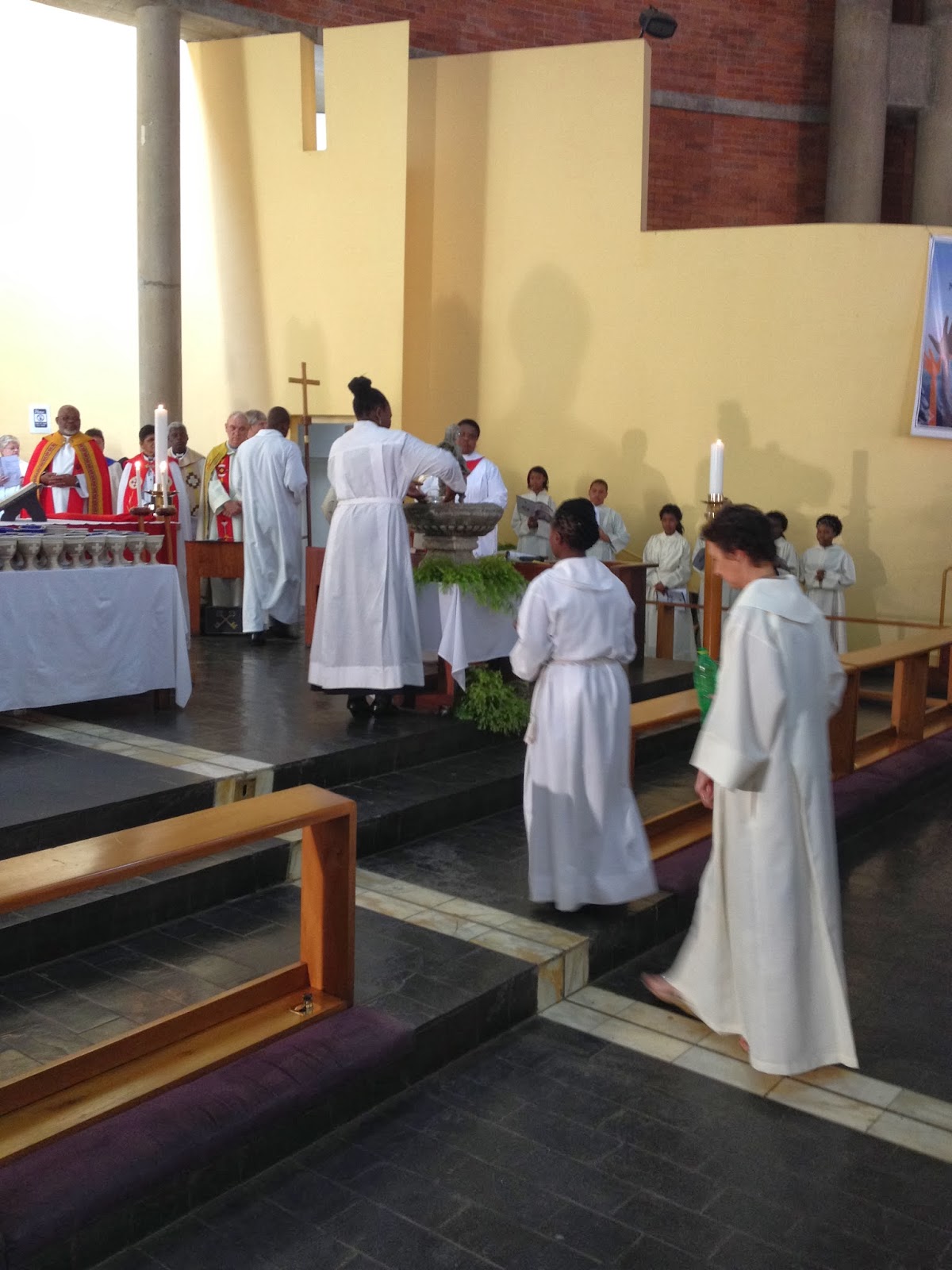
Today I took part in the celebration of the 160th Anniversary of the Diocese of Natal. I was invited by the Dean of the Cathedral of the Holy Nativity and this meant I found my place with about 50 other priests in the procession. I brought both my white and red stole. I supposed that we were to wear red but you never know. But red it was, the 30th November being the day of St. Andrew, patron saint of this diocese. In church red is the colour of the blood of the martyrs. But in Africa red is also the colour of joy!

One little question I have is why this Diocese is called the Diocese of Natal. Since 1994 the province is KwaZulu-Natal. This is something I need to ask someone about.

The celebration had the form of a high mass led by bishop Rubin and the two suffragan bishops. I just want to highlight a few things. First I want to say something about the Blessing of the Water, when lay representatives from different regions carried water from the different parts of the diocese and poured it into a font, with a fountain. It was a nice symbol. The geographical, earthly side of the Church! It was followed through in the Eucharistic prayer with the words:
In your infinite wisdom, you created earth and made it pregnant with new life. You reveal your mighty power to us in the ragged peaks of the uKhahlamba Drakensberg and in the mysterious depths of the Indian Ocean.
It was for the first time I heard geographical names in a Eucharistic Prayer. I liked it!

Second I want to mention the liturgical dance. And especially the two paradigms that met. One the one hand the hierarchical processions, where there are one cross in the front, but then another processional cross for the suffragan bishops and finally two crosses (I think they are called something else) for the diocesan bishop. When the women came dancing in the isle the body language tells something else. Still I like this kind of clashes and mixing of different symbols. It was only when bishop Rubin cracked a joke, saying that the bishops would dance later (which of course never happened) that I felt a bit sad. Had Archbishop emeritus Desmond Mpilo Tutu been there I am sure he would have joined the dancing.


Most probably the three bishops wanted to take part in the dancing.

Finally I want to say something about the sermon. It was again bishop Rubin who preached. He is maybe not the most radical of bishops but his message was good. The church needs to be a church in mission. He only mentioned one of his predecessors and that was the first bishop of the Diocese, bishop Colenso. I think I will dedicate a separate blog post to him. He was a very special person, at one stage suspended by the bishop of Cape Town, something he did not accept. (More about this later!) He was supporting the rights of black people in the 19th century and got the African name: Sobantu (mening “father of all people” in isiZulu). How fitting that I will preach in the Lutheran Church in the township called Sobantu tomorrow!

Tuesday, 2 October 2012

The Marikana shootings, justice and healing

Today I come across two reactions to the Marikana shootings. Both are expressed by church leaders in South Africa. I think they relate to one another although they don’t address the same aspects.

The Anglican Archbishop of Cape Town, Thabo Makgoba, has a blog. This week he publishes a letter to the President of South Africa, Jacob Zuma. In the letter the Archbishop strongly urges the President to make state funded legal representation available to families of those mine workers, who were killed at the Lonmin mines in Marikana in August this year. Apparently the Government is funding the legal representation of the police, who killed mine workers but similar legal support is not being extended to the miners themselves nor to the families of those who lost their lives. It is not often that the Archbishop nowadays writes this kind of appeals to the President. Former Archbishop, Desmond Mpilo Tutu, often did so. It is a good sign. Archbishop Makgoba ends his letter in the same tradition as Tutu used to do:
Please be assured that you remain always in my own prayers, and those of the Anglican Church of Southern Africa, that God will bless you with his wisdom and grace to follow his best paths in all you do, so that you might be a blessing to this nation, and to all its people.

Yours in the service of Christ

+Thabo Cape Town
Another example where the Marikana shootings are commented on comes from Fr Michael Lapsley, also an Anglican Church leader. He is the founder of the Institute for Healing of Memories. In an interview in the Mail and Guardian he is described as a struggle veteran who became a healer. A letter bomb in 1990 shattered both his ear drums, destroyed one eye and blew off both hands. He then discovered his new calling, namely to become a healer of the South African nation. He says that the Marikana shootings is the latest example that South Africa is still a traumatised nation.
We need to find a way of listening to each other and not simply shouting past one another. But that also needs to be coupled with the challenge that the income distribution between rich and poor in South Africa is the most unequal on earth. We need to speak not only about poverty but also about greed.
I hope that many more Church leaders start to voice their critique. To me it brings hope. Do we hear a voice like this in Sweden? Well, it happens that our own Archbishop, Anders Wejryd, writes letters to our Prime Minister. Last year he critisised the Swedish Government for voting against the Palestinian application to join United Nations' cultural organisation UNESCO. He also strongly opposed Sweden’s arms export in an article in Dagens Nyheter last year. But when does he critisise the Government for injustices in the Swedish society?

Sunday, 9 September 2012

Kairos Palestine

After 5 years in South Africa and after writing my thesis about the prophetic voice of the South African Council of Churches (SACC) the Kairos concept is very familiar. It has been used a lot in South Africa after the launching of the Kairos Document in 1985. It has been said that the fight against crime is a Kairos, the fight against HIV and AIDS is a Kairos and recently that the momentum in the struggle for sustainability in the Environment is a Kairos. I have not studied the Kairos Palestine Document enough. This I realized earlier today when attending a seminar at the S:t Paul’s Church in Malmö at Världens fest.
Kairos Palestine: a Christian Call for justice and peace in the Israeli – Palestinian conflict – who is listening?
It was amazing to listen to one of the authors: Father Jamal Khader. According to the Kairos Palestine website
Fr. Jamal teaches at the Latin Seminary in Beit Jala, Bethlehem University, the Emmaus Center in Beit Sahour, and Mar Elias College in Ibillin. He also teaches Peace Studies and Conflict Resolution Strategies for the master's in International Cooperation and Development (MICAD) program. Fr.Jamal is the Chairperson of the Department of Religious Studies and the Dean of Arts at Bethlehem University.
With a lot of energy he told us about the dire need for Hope in the current situation. I will try to give a short resume of what he said: The situation in the Holy Land today is no longer first page news. But for the people in Beit Jala, threatened to be divided by the wall and diminished into about 20% of its original size [if I recall rightly what Fr Jamal said] it should be first page news. Israel started to build the separation wall in 2003. Then there were about 200 000 settlers on occupied ground. Today they are almost 650 000. There is a plan to have only 12 % Palestinians in Jerusalem by 2020. Today they are 23%. Young Palestinians are starting to lose hope. And not without reason, Fr Jamal says. I got really upset when he told us, that Sweden voted against Palestinian membership in UNESCO. I did not know! But the people of Palestine will still not give up. They know what despair is but also that collaborating with God means hope.
If Gods plan is that we should live together we want to live together.
A bit surprising was his view that there is no conflict. A conflict is when two parties are having different values or aspirations. In a conflict there are things to discuss. There is room for negotiations. But in this case he only said that the occupation is evil. I could also hear an echo of Archbishop emeritus Desmond Mpilo Tutu when he said that liberation for the Palestinian people also means liberation for the oppressors. The Kairos Palestine Document wants to illegitimate occupation, not Israel. It is a very inclusive document. The expression “for all” is used 46 times.
Israel deserves to live in peace and security. Neither the wall nor soldiers will give them that security.
He continued to state that the time for a two states solution almost is gone. There is already an Israeli state but the Palestinians don’t get theirs. He was specific in our context and said:
You as Europeans are supporting occupation.
So he turned to theology and said that the Bible never can be used to justify injustice. The criteria of every theology must be: What are the consequences? Finally he gave some feedback to Church of Sweden. He spoke about costly solidarity and meant that Church of Sweden is showing that. By visiting both sides in the situation and by continuing to support different institutions in the Holy Land. He urged us to revisit our biblical theology and to continue to dialogue with the Jews. On that note he contextualized the whole dialogue concept. In the Holy Land dialogue between Christians and Jews means one thing. The Jews are in majority and the Palestinian Christians in minority. In Europe it is totally different, which makes the dialogue quite different. I have to admit: I never supported the document on the website. It is possible to do that on the website. I will now read it thoroughly and probably I will support it after having read it. Only Palestinians can sign it. Others may support it. Right now there are more signatures then supporters. I think we have to change that.

By the way: The website has a nice address, ending with ".ps" which means "Palestine". At least Palestine exists on the World Wide Web, Fr Jamal said.

Sunday, 8 January 2012

ANC 100 år 2

Sydafrika upphör aldrig att förvåna mig. ANC firar 100 år. Det är ett parti som firar men själva firandet framstår som ett firande för hela nationen – kanske hela kontinenten. Drygt 40 statschefer är där. Samt en del före detta. Kaunda exempelvis. Gratulationer kommer från alla hall. Storbritanniens Cameron säger enligt iol-news:
The African National Congress has been a beacon for the world in the fight against discrimination and the struggle for freedom from oppression - it stood up for the rights of all South Africans.
It is incredible to see the changes in South Africa that the ANC has helped to bring about.
ANC och Desmond Mpilo Tutu har verkligen haft många konflikter. Han är en av få som tydligt kritiserar ANC och dess ledare. Men vid invigningen av 100-årsjubileums-facklan satt Tutu bredvid Zuma. Zuma tände och Tutu välsignade. Det kan man se på ett klipp, som Reuters har.
Ett knappt dygn efter det rituella slaktandet av en tjur, för att förfäderna (och förmödrarna) skulle involveras i firandet, invigdes facklan under en gudstjänst i en metodistkyrka. Här blandas friskt. Forna kombattanter uppträder sida vid sida. Sydafrika! Fascinerande.
Men det hörs även en del kritiska röster. Insmuget i hyllningsropen talas det om de utmaningar som verkligen finns. Även Zuma talar om det i sitt stora tal, som delvis återges av BBC.
Men visst har ANC en stolt och stundtals häpnadsväckande historia. Kampen fördes utan våld i 50 år och när man till sist tog till våld var det i jämförelse med apartheid-regimens övervåld begripligt. Ledare som Oliver Tambo och Nelson Rolihlahla Mandela har gett försoning ansikten. Nog finns det mycket att fira, även om det går att rikta kritik mot de nuvarande ledarna.
Det intryck jag får är att ANC förmår vara en enande kraft för en stor del av landets befolkning. I vilken utsträckning flertalet vita upplever att det är deras firande, ska jag låta vara osagt.
På SACC’s hemsida finns det inget att hämta om jubileet. Så sent som 22 december riktas dock skarp kritik mot Zuma, för att han uttalat sig negativt om kyrkornas roll i Sydafrika.
Det ska bli intressant att läsa kommentarer i den närmsta framtiden.

Monday, 21 November 2011

Avhandlingens väg över oceanen

Måndagen den 13 september 2010 disputerade jag. Avhandlingen fanns då i ett fåtal exemplar. Några häftade och några inbundna, enligt fakultetens anvisningar. I Sydafrika är det inte brukligt att man trycker sin avhandling. Vilket det är i Sverige.
Redan innan disputationen hade jag ansökt om medel att trycka avhandlingen. Jag hade fått ett par positiva förhandsbesked (och några negativa). Jag bedömde att de utlovade pengarna skulle räcka, för att trycka erforderligt antal avhandlingar. Därför påbörjade jag processen redan nere i Sydafrika genom att sätta mig med min redaktör, Mike McCoy, och gå igenom hur vi skulle jobba.
Väl hemma i Sverige kom mycket annat emellan men i februari 2011 var det mesta klart. Mike och jag hade tät kommunikation och det såg ganska bra ut, vid tryckeriets dead-line. Enda detaljen var själva person- och sakregistret, som jag skapade en mörk februarinatt. Men när jag fick korrekturet hade alla sidhänvisningar kommit fel. Kris!
Stryk hela registret!
Så kände jag och så skrev jag till Mike. Men han kunde ordna det genom något slags uppdateringskommando i ordbehandlingsprogrammet. (Nu har jag sett att det finns några fel kvar, men det får vara!)
Målet var att det skulle finnas en del avhandlingar till ett seminarium i Lund 23 maj, där jag medverkade med ett s k ”paper”. Det fanns det också. Med hjälp av en gästande sydafrikansk professor. Resten av avhandlingarna skulle sedan skeppas med båt. Piece of cake!
Eller inte. Det visade sig att någon (tryckeriet eller Mike) behövde ett exporttillstånd. Det blev Mike som fick ansöka om det. Och det tog viss tid. Sedan kunde processen startas. Böckerna skickades någon gång i höstas. Jag visade avin för min son sjömannen, som kunde utläsa att böckerna skulle lastas om i Hamburg.
När jag skulle åka till London häromveckan fick jag ett mejl från ett företag i Göteborg, som sköter förtullning mm. De meddelade att böckerna nått Hamburg. Och att de skulle förtullas där. Den tyska tullen behövde kopia på min faktura. Att jag betalt böckerna. Detta gick att ordna. Jag satt på tåget och hann precis mejla Mike, få svar och skicka det vidare innan vi passerade gränsen till Danmark och jag stängde av min iphone. Men när vi kom till London, fick jag veta att tullen hade stött på problem. På fakturan stod: 400 böcker och i lasten fanns bara 250. Vad har hänt med de andra 150? (Jo, de hade jag lämnat i Sydafrika hos Mike, som distribuerat de flesta till bibliotek, universitet, privatpersoner m fl.) En av böckerna hade jag skickat till Desmond Mpilo Tutu.

Hans sekreterare svarade såhär:
Dear Anders
On behalf of Archbishop Desmond Tutu I thank you very warmly for sending him a published copy of your doctoral thesis on the South African Council of Churches after 1990. Congratulations on your achievement.
The book will be shown to the Archbishop who I am sure will find it of interest because of his association with the SACC.
Yours sincerely
Anne Field
Office: Archbishop DM Tutu
Detta behövde tullen veta. Ja, kanske inte just vad Tutus sekreterare skrev men att boken distribuerats i Sydafrika. Nu kunde man stanna upp och något reflektera kring narkotika, trafficking, människosmuggling, vapenexport, valutahandel mm. Men jag ska inte bråka!
Jag hade bett hustrun hålla kontakten med företaget i Göteborg (vanguardlogistics) och hon föreslog att den på Londonresan medföljande kyrkoherden skulle anlitas. Varför? Jo, efter ett antal år i Berlin, torde han behärska tillräckligt god tyska, för att kunna författa en förklaring till tullen. Så skedde och böckerna kunde påbörja den näst sista etappen till Göteborg.
Dit kom de i morse. Jag fick telefonbesked att jag nu förväntades betala allehanda avgifter, vilket jag gjorde direkt. Men det borde jag inte gjort. För det kom ett till mejl, som sa att det var viktigt att pengarna skickades till bankkontot och inte bankgirot. Jag hade så klart valt bankgirot, eftersom det stod överst på fakturan. Här kunde ha uppstått problem, eftersom bankgirot tar något längre tid än bankkontot. Såvida jag inte hade gjort en s k skärmdump. Vilket jag hade! Mejlade alltså denna skärmdump från internetbanken och fick svar från företaget (denna gång ej vanguardlogistics utan KGH Customs Services). Nu var allt frid och fröjd och jag hoppas därmed att de 250 böckerna vägandes 178 kg är på väg mot Kalmar med lastbil.
När de väl är här återstår att distribuera lämpligt antal i landet. Universitet, bibliotek, andra institutioner, facktidskrifter mm. Men det känns enbart inspirerande.

Friday, 7 October 2011

Hur stort är Afrika?

Denna bild åker nu runt i cyberspace. Jag måste säga att jag själv gör misstaget många gånger att tala om Afrika som vore det något homogent. På ett sätt är det ju det. En kontinent. Klart avgränsad med några större och mindre öar. Men hur stor är inte denna del av världen? Och hur många folk, kulturer, språk, religioner osv finns inte representerade? Nigeria – den folkrikaste nationen – har över 150 miljoner invånare. Enligt wikipedia finns det 527 katalogiserade språk. Vi talar nu bara om en enda nation. 55 länder finns det. 1 miljard bor i Afrika. Också detta enligt wikipedia.

Vad spelar då denna kunskap eller insikt för roll? Jo, vi tenderar att generalisera, när det gäller Afrika och finna trygghet i denna generaliserade bild. Det tror jag inte hjälper upp världsläget. Nej, låt oss ta in en något mer komplex verklighet. Ja, det finns enorma problem i Afrika men det finns också unika möjligheter. Visst, det finns korruption så det kunde räcka för generationer framåt men det finns också människor, som osjälviskt ger allt.
Därför är det fantastiskt att Norska Nobelpriskommittén gett tre kvinnor nobelpriset, varav två kommer från Afrika. Grattis inte bara till Ellen Johnson Sirleaf, Leymah Gbowee ochTawakkul Karman utan också till alla andra kvinniskor och människor i Afrika och även Jemen och resten av världen.
Idag, när Desmond Tutu fyller 80 år och idag, när det är den Heliga Birgittas dag.
Det värmer – en verklig brittsommar – både i Skandinavien och på denna enorma kontinent, som vi kallar Afrika – motherland.
Long live the mothers of Africa.

Monday, 24 January 2011

Ärkebiskop Tutu och jag

Ärkebiskop emeritus, Desmond Mpilo Tutu, och jag ska bli kollegor. Den 27 januari blir han hedersdoktor (doctor honoris causa) vid den teologiska fakulteten, vid University of the Free State i Bloemfontein i Sydafrika. Där är även jag doktor. Nu ska jag ju inte skryta men jag var faktiskt där före den gode Tutu. Med denna enkla bloggpost vill jag välkomna honom!

Mer viktig är anledningen till att han blir hedersdoktor. Det är ett led i universitetets och dess rektors (Jonathan Jansen) strävan att förändra relationerna mellan svarta och vita studenter på campus. Universitetet ska lansera sitt ”International Institute for Studies in Race, Reconciliation and Social Justice”. Det är bra att universitet arbetar med dessa frågor. Möjligen börjar det finnas väl många institut med detta tema i Sydafrika. Men det är också en spännande möjlighet för mig att kanske få intresse kring min avhandling. Institutet ska publicera ” groundbreaking research”. Vi får se om mitt arbete bedöms höra dit!

Friday, 26 December 2008

Äntligen har jag funnit Jesus!

Annandag jul! Det kändes fint att få dela gemenskapen med systrar och bröder i Heliga korsets kyrka. Högmässan startade kl 10 och en kort cykeltur i några minusgrader var precis den friska start på dagen min julmatsstinna kropp behövde.
Annandagens tema är Martyrerna! Viktig påminnelse mitt i julfirandet. Att vara kristen kan få konsekvenser. Jag tänker också att många andra, icke kristna, genom historien fått bli martyrer. Det är ju lika illa, om en ateist eller muslim blir förföljd för sin tros skull. Lika illa! Men idag funderar vi över våra egna trossyskon!
Väl hemkommen tar jag fram en av julklappsböckerna. Rättvisans rebell! Handlar om Desmond Tutu. Det är Kristina som har fått den. Egentligen hade jag önskat mig den engelska utgåvan. Rabble-Rouser for Peace. Desmond Mpilo Tutu kan man ju kalla martyr. Både i grundbetydelsen, d v s en som vittnar och i den överförda betydelsen: En som vittnar och p g a det får lida för sin tro.
Jag minns en annan bok av Tutu. Där beskriver han Guds nåd som en tvättmaskin istället för en dammsugare. Dammsugaren tar visserligen också bort smutsen, men den stannar kvar inuti. Tvättmaskinen sköljer bort all smuts. Den försvinner ut i avloppsnätet och är borta för alltid. Så fungerar Guds nåd. Jag tänkte använda den bilden i en predikan under mina år i Sydafrika men insåg att de flesta i den församling som vi tillhörde saknade både dammsugare och tvättmaskin.
Men associationen får mig att inse att vårt hem har varit befolkat av fler personer än vanligt under juldagarna. Och vid två-tiden kommer ett nytt julekalas. Alltså behöver bordsduken ner i tvättmaskinen och golven dammsugas.
Under soffan i gillestugan ser jag något svart. Innan jag hunnit suga upp den tänker jag: Kanske är det Jesus!
Saken är den att yngste sonen, delvis mot föräldrarnas vilja, började förstora ett av de hål, som redan fanns upptagna i örsnibbarna. Nåväl, han var på god väg att fylla 17, så kanske bör man i den åldern få ha lite självbestämmande. Vi var inte så glada åt idén. Men sonen bedyrade att hålet inte skulle bli större än 1 cm i diameter. (Vi såg ju framför oss de afrikanska örsnibbar, som nästan nuddar axlarna efter år av uttöjning. (Något vi bara sett på bild och under fyra år i Afrika aldrig sett i verkligheten.) Veckorna gick och till slut skulle uthålligheten belönas med ett slags örhänge. Stolt visade sonen upp en liten ikon, föreställande Jesus, som prydligt satt på plats i nämnda hål. De sista resterna av föräldrarnas eventuella ovilja rasade som ett korthus.
Att som långhårig, skäggig med kedjor i byxorna och nitar runt handlederna försedd tonåring vittna om sin tro, genom att bära Jesus i ena örat, den imponerade på både modren och fadren.
Men häromveckan försvann Jesus. Illa! Och som den uppmärksamme läsaren nu förstått, var det just denne Jesus som återfanns vid dammsugningen under soffan.
Så det kan löna sig att besöka kyrkan på Annandag Jul, få höra en god predikan om martyriet, gå hem och läsa en bok om en Sydafrikansk martyr vid namn Tutu och få idén att det borde städas upp lite i hemmet och därmed finna det som trots allt är Julens centrum: Jesus!