Showing posts with label Cathedral of the Holy Nativity. Show all posts

Wednesday, 25 March 2015

The feast of the Announciation

Is it your birthday?
One of the priests in the Anglican Cathedral of the Holy Nativity was surprised to see me this morning for Eucharist at 6.45 - I preside every Thursday and do not often attend other mornings. I told him that the reason for my presence was the feast of the Annunciation. In Church of Sweden it is always celebrated on the Sunday closest to 25 March but not so in most of the churches in South Africa. To me it is an important occasion. When I think of St Mary, I see her as a role model in saying yes to God and availing herself to give birth to Christ in the world. I also want to carry Christ into my context. And I thank God for other Christians who carry Christ to me.

That's why I decided to start this morning with a Eucharist. As the bread and wine become one with my body, I believe that Christ is with me.

Richard is a retired priest who leads the service every Wednesday. Naomi is recently ordained.
She was one of my students at UKZN. Sr Nontokosi is a religious sister, living at the Cathedral.

I like the architecture of the Cathedral. The idea is that the wall
stretches out into the street, like an arm, to invite everyone to worship.

Sunday, 22 February 2015

Today's sermon

Service in the Anglican Cathedral of the Holy Nativity
first Sunday in Lent 22 February 2015 at 7 and 8.30
Texts: Genesis 9:8-17, Psalm 25:1-10, 1 Peter 3:18-22, Mark 1:9-15
Your bow in the clouds proclaims your covenant …
A bow - the rainbow - a rainbow nation!

The first reading, from Genesis 9:8-17 is part of a biblical narrative that so many people in the history of humankind, have identified with.

We see the rainbow as a symbol for many things.
  • South Africa, a rainbow nation
  • The Gay and Lesbian community uses a rainbow flag
  • Greenpeace had a boat called rainbow warrior, sunk by the French intelligence service in 1985 in Auckland, New Zealand.
  • A Swedish Rema Church has it in its logotype.
We all love the rainbow. It reminds us of the covenant.

But the narrative is problematic.

It says:
… never again shall there be a flood to destroy the earth …
Say that to the people of Malawi and Mozambique some months ago …

Never again …

It reminds me of the speech that Nelson Rolihlahla Mandela held at his inauguration as President of South Africa in Pretoria 10 May 1994:
Never, never and never again shall it be that this beautiful land will again experience the oppression of one by another and suffer the indignity of being the skunk of the world.
How about today? With xenophobia and corruption?

But there are also other problems. The narrative speaks about a covenant. We know how this concept has been used and abused.

The covenant that God made with the Afrikaner people at the battle at Blood River or Ncome river. 16 December 1838.

And if we continue to read in Genesis 9 we get the story of Noah drinking wine and getting drunk, which results in him taking of all his clothes and falling asleep in his tent. One of his sons, Ham, sees him naked (a taboo) and a curse is cast on the grandson, Canaan:

Noah wakes up and says:
Blessed by the Lord my God be Shem; and let Canaan be his slave.
May God make space for Japheth, and let him live in the tents of Shem; and let Canaan be his slave.
These verses were used by the apartheid theologians as a way to explain why black people should serve white people.

Isn’t it strange how we make use of the biblical text, the word of God, to further our own privileges?

Let’s go to the Epistle text where we learn about the New Covenant through Christ. Peter writes about
… the days of Noah, during the building of the ark, in which a few, that is, eight persons, were saved through water. And baptism, which this prefigured, now saves you—not as a removal of dirt from the body, but as an appeal to God for a good conscience, through the resurrection of Jesus Christ.
But even in this context, in the beginning of the same chapter, Peter writes about how wives must accept the authority of the husbands. He describes women as the weaker sex.

Haven't these verses been used for oppression? Although Peter also says that husbands must show consideration for their wives. A verse we men often forget to read.

Always those contending voices in the bible; oppression and slavery side by side with liberation and salvation!

It is not strange. Even in Jesus’ own life here on earth there was a spiritual war. A fight between powers! The middle section of the Gospel tells us what happened directly after Jesus’ baptism and reads like this:

And the Spirit immediately drove him out into the wilderness. He was in the wilderness forty days, tempted by Satan; and he was with the wild beasts; and the angels waited on him.

These were the different characters in the drama:
  • Jesus
  • The Spirit
  • Satan
  • Wild beasts
  • Angels
Of course the Biblical narrative is influenced by the evil power in the same way.

But the Word of God – which is Jesus Christ – is there. In the middle of the Bible and in the Church!

When we enter this time of lent we do it with an objective to live close to Jesus; to walk beside Jesus or allow Jesus to walk next to us.

We need to revisit the Bible, as in the Lent Course, every Wednesday up to Easter.

We need to engage with one another in the congregation. Yes, we may and we should read the Bible on our own but even more, we should do it together.

We should also allow the Holy Spirit to guide us, when we share the bible.

So that we may understand, on a deep level, that we really are in a covenant with God. A covenant which is not there only for our sake! We should not forget others.

It is a covenant that God made with us and
… every living creature that is with you, for all future generations
There can be no oppression. We are in this together.

Let us digest this during lent. Let us pray to God, that we become Christ-like in loving the whole world, just as God loves the whole world.

There will be other forces in our lives. Trying to distract us, trying to draw us away from what is right.

Let us therefore also see lent as a time to live closer to Jesus in this sense, asking for his grace and forgiveness.

It is only in him and through him we can achieve this.


Thursday, 25 December 2014

Makgoba preaches against inequalities

The Anglican Archbishop in Southern Africa, Thabo Makgoba, used the oppurtunity given to him in the Midnight Mass at the St Georges Cathedral in Cape Town, to preach prophetically about the situation in today’s South Africa.

On his blog you can find media reports from SABC News and a YouTube clip. The Arch spoke about economic inequality among other things.

We too attended a Midnight Mass, in the Anglican Cathedral in Pietermaritzburg, where Dean Ndabezinhle Sibisi also spent time talking about the present situation. One thing that he urged us to fight against was the fact that so many women and children are being abused.

Emmanuel. God with us. Especially with the poor, as the dean said. But he also underscored, that there are different kinds of poverty. And the worst thing is when we are spiritually poor, without being aware.


In the beginning of the Midnight Liturgy the Crib of the Cathedral of the Holy Nativity was blessed.


Sunday, 23 November 2014

Domssöndaghögmässa med julspel och urnnedsättning

Ungefär en gång i kvartalet blir jag ombedd att predika i den anglikanska katedralen på orten. The Cathedral of the Holy Nativity. Den Heliga Födelsens Katedral. Idag var en sådan söndag. Det innebär att jag predikar och leder den tidiga högmässan som startar kl 7. I den senare, som startar 8.30, är det bara min uppgift att predika. Inför denna söndag hade jag fått veta att predikan i gudstjänst nr 2 skulle vara kort, eftersom det också skulle bli julspel. Söndagsskolans julspel. På Domssöndagen? Just det!

I ett svenskt perspetkiv känns detta underligt men i Sydafrika helt normalt. Skolåret slutar ungefär nu. Sedan är det sommarlov. Då blir det svårt att få ihop ett julspel. Alltså måste det äga rum nu. (När vi bodde i Sydafrika med våra barn var det alltid Carols-gudstjänster i mitten av november. Då var det extra logiskt, eftersom skolorna delvis var internatskolor och många elever bodde på andra platser.)

Det andra som var annorlunda i högmässa nr 2 var att det också skulle bli urnnedsättning. Bakom katedralen finns en liten minnesträdgård med urngravar. Någon hade gått ur tiden och dennas aska skulle nu placeras i en av dessa gravar. Detta skedde mitt i högmässan, samtidigt som det var pålysningar. Ungefär 20 minuters pålysningar gjorde att släkten (som var över 50 personer) hann tillbaka i tid till söndagsskolans julspel.

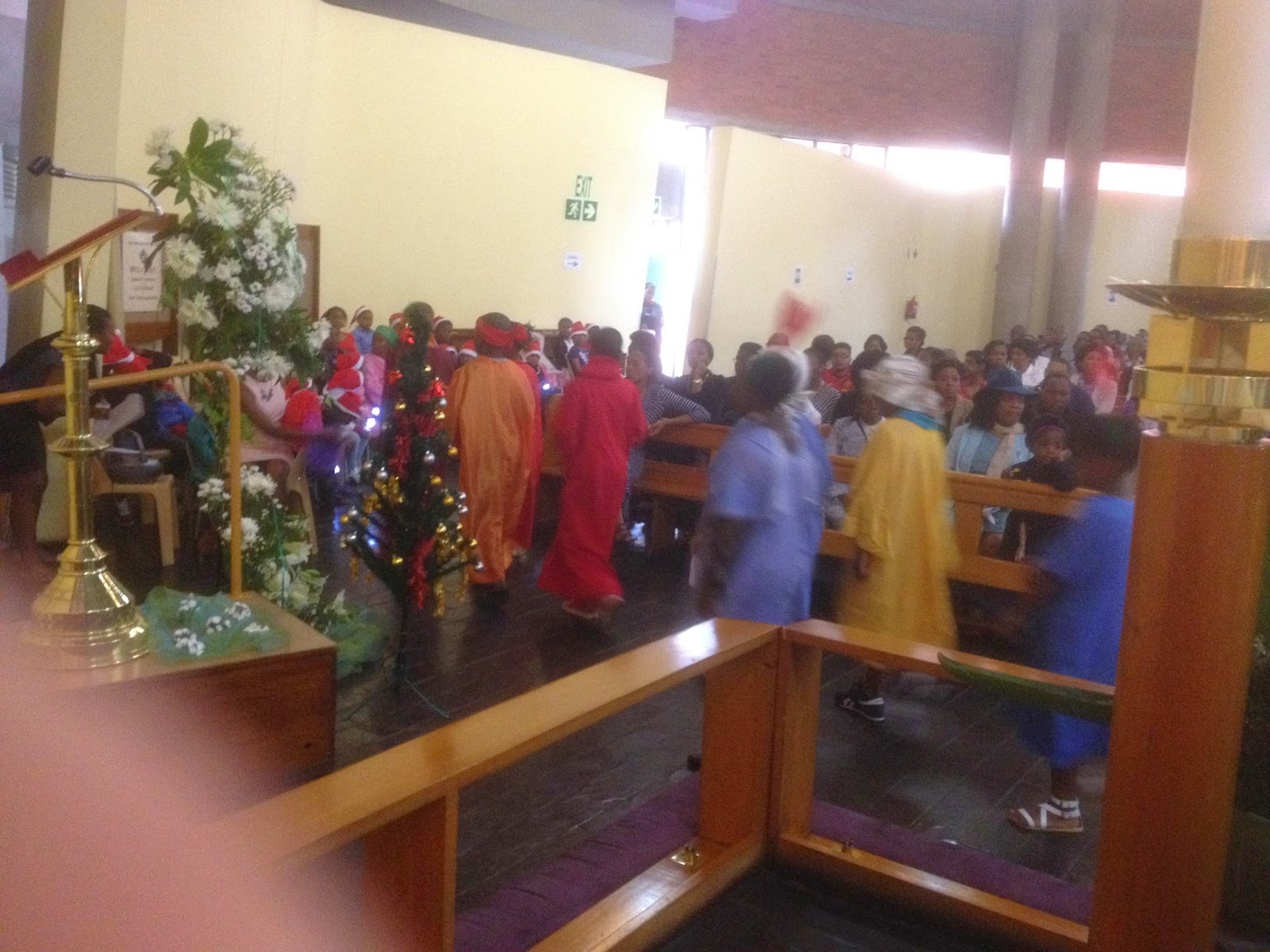
Dessa två saker skapade en del intressanta effekter i rummet. De små barnen satt på stolar långt från altaret och de kom aldrig fram, när det var dags för julspelet. Men alla hade tomteluvor på sig. Och höll i batteridrivna ljus. Märkligt tyckte jag. Varför ska de sitta vid sidan av? Men när Maria hade blivit gravid och skulle föda, lämnade hon altaret och kung Herodes och gick bort, med Josef, till småbarnen och där skedde födelsen och dit gick sedan stjärntydarna. Kanske även herdarna, fåren och två renar (!) samt änglarna.

En annan rumslig märklighet var ju när 50 personer gick ur kyrkan för urnnedsättningen.


Samtidigt var det befriande. Allt behöver inte vara så perfekt, väloljat och regisserat. Det går bra ändå. Som t ex att organisten var sjuk idag. Det fick prosten veta 10 minuter före gudstjänsten började. M
aken till den som skulle urnnedsättas, kom in i sakristian 5 minuter före högmässan startade och lovade ta ansvar för att starta alla psalmerna .Även kören verkade minimalt berörd av att deras körledare inte var där. De sjöng ändå. 

Hade någon i Sverige föreslagit julspel på domssöndagen hade jag säkert hoppat högt och sagt nej. Likaså hade jag tvekat inför att att ha urnnedsättning under högmässan. Men än är det inte för sent att lära sig. Och lärdomen är:
Det gör inte så mycket om det blir lite annorlunda.

Det viktiga fanns definitivt där. Eukaristin, Guds Ord, församlingsgemenskap, delaktighet. Och inte minst en tydlig sändning ut i världen. Dit, där kyrkans uppdrag blir tydligt. Inte minst på Domssöndagen.
Dags för urnnedsättning - mitt under högmässan.
De minsta barnen satt verkligen 'off-side'.


Renarna stod med herdarnar. I Sverige hade det varit
extra kontextuellt.

En höggravid Maria lämnar koret och går mot småbarnens hörna.
Stjärntydarna och Herodes.
Till slut samlas hela julspelet kring de mindre barnen. Sympatiskt.
En bra kör reder sig själv. Även om organisten/körledaren hastigt insjuknat.
Under hela gudstjänsten väntade de eukaristiska gåvorna på
det bord, som kallas kredensbord. Sedan blev det måltidsglädje.
Därefter sändes vi ut i världen. 

Saturday, 24 May 2014

The Anglican - Roman Catholic International Commission

Wednesday evening we visited the Emaphethelweni Priory (Dominican) here in Scottsville, Pietermaritzburg. The occasion was a seminar around ARCIC (The Anglican - Roman Catholic International Commission). In the commission, which is now named ARCIC III there are two representatives from Africa. Both were present at the Emaphethelweni Priory on Wednesday. Professor Teresa Okure, a sister of the Society of the Holy Child Jesus, and professor of New Testament and Gender Hermeneutics at the Catholic Institute of West Africa, Port Harcourt, Nigeria was one of the persons. The other one was Bishop Suffragan Nkosinathi Ndwandwe from Natal Diocese, Anglican Church of Southern Africa. We often fellowship together in the morning Eucharist in the Cathedral of the Holy Nativity.

It was interesting to learn more about this commission. From the start (1967) it was quite successful but later on the process slowed down due to disagreement over the ordination of women and also around human sexuality.

The two speakers focused especially on the Eucharistic division. With distress they told us about their last meeting, when they visited an ecumenical communion where people freely shared in the Eucharistic fellowship (even Roman Catholics). The members of the commission however were told (I can’t recall by whom) that they were not allowed to take part. We could see how hurtful the experience had been.

Sr Teresa is showing how they were blessed in the Eucharist service instead
of receiving the Body of Christ. She uses Bishop Nkosinathi in this small roleplay.

Interestingly enough, when I greeted Prof Okure, we directly realized that we had a common friend, Hans Engdahl. I know that he and Prof Okure have done some academic work together.

After the two speakers had talked we were allowed to ask questions. I especially remember one participant who spoke about the dying churches in Europe. He reacted to the way that Europeans dominates ARCIC. No representative from Latin America, only two from Africa and maybe also two from Asia but a whole bunch of people from Europe. How can this be, when the churches in the global south are growing and dying in Europe?

A relevant question! Let’s hope that ARCIC IV will respond to that. There are important questions to deal with. If I understood it correctly the commission doesn't discuss issues on human sexuality, because the Anglican Communion is also divided within itself. I still believe that the church leaders need to start discuss exactly those kind of questions.

As much as I hope the human sexuality could be put on the agenda, I also realize that not all African Christians would like that. I am puzzled how issues around human sexuality and family can be so provocative. The only answer is that it has to do with power. Even more important than, to discuss those issues openly. One the one hand is the unity of the church, which is important. On the other is the life of for instance homosexuals in our midst. Which is equally important. I believe that the unity of the church is of utmost importance also for minorities. But questions around power need to be asked all the time. For whom? By whom? Also when we discuss the Eucharist! For whom?

Monday, 10 March 2014

Anglican and Lutheran


Of course I am a Lutheran. But I also enjoy fellowship with the Anglican Church. In the pew leaflet of the Anglican Cathedral of the Holy Nativity one can read this:
LENT BIBLE STUDIES

Pontius Pilate and Jesus: About Power Relations.

Every Sunday we mention the name of the ancient politician Pontius Pilate. Why is he so important? In five Bible Studies we take a look at the relationship between Jesus and Pontius Pilate and together we draw conclusions for our own lives.

The Lenten Bible Studies will be led by the Revd. Dr. Anders Goranzon, (MDiv,PhD) on Wednesdays in the Colenso Hall starting at 17:30.

Please make every effort to attend. 
I look forward to this. I will lead the Bible Studies in the tradition of CBS = Contextual Bible Studies. Through engaging with the person Pontius Pilate we will understand more about ourselves and our own time.

This takes place on Wednesday evening. Thursday morning at 06h45 I lead the morning Eucharist and coming Sunday I preside and preach in the first service at 07h00 and in the second service at 08h30 I preach.

This week I spend a little bit more time in the Anglican Church then in the Lutheran. But Sunday the 23 I will be back in my own tradition and preach at the Lutheran Theological Institute - LTI.

After all there is only One, Holy, Catholic, and Apostolic Church.


Saturday, 30 November 2013

Anglican Diocese of Natal 160 years

Today I took part in the celebration of the 160th Anniversary of the Diocese of Natal. I was invited by the Dean of the Cathedral of the Holy Nativity and this meant I found my place with about 50 other priests in the procession. I brought both my white and red stole. I supposed that we were to wear red but you never know. But red it was, the 30th November being the day of St. Andrew, patron saint of this diocese. In church red is the colour of the blood of the martyrs. But in Africa red is also the colour of joy!

One little question I have is why this Diocese is called the Diocese of Natal. Since 1994 the province is KwaZulu-Natal. This is something I need to ask someone about.

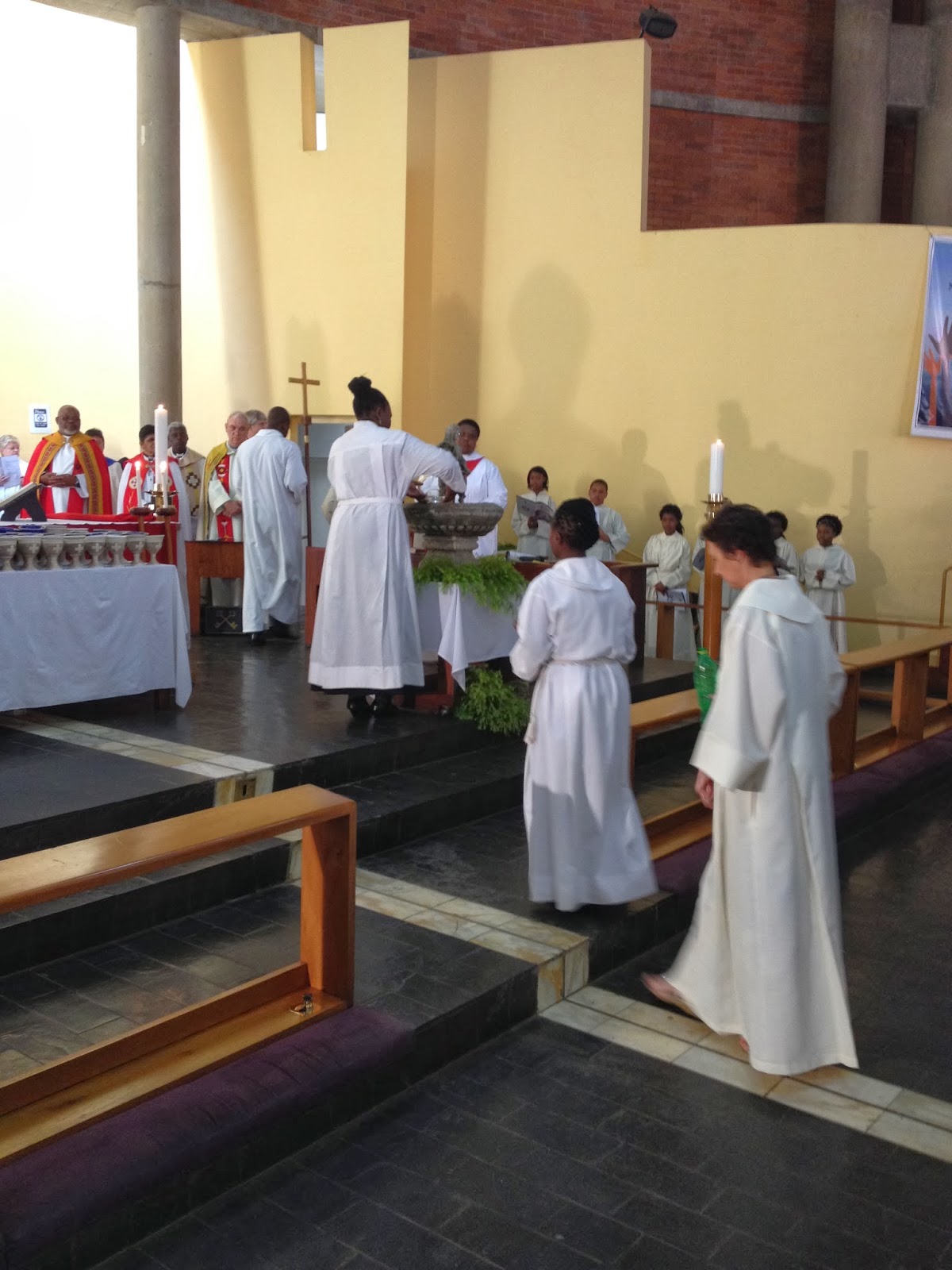
The celebration had the form of a high mass led by bishop Rubin and the two suffragan bishops. I just want to highlight a few things. First I want to say something about the Blessing of the Water, when lay representatives from different regions carried water from the different parts of the diocese and poured it into a font, with a fountain. It was a nice symbol. The geographical, earthly side of the Church! It was followed through in the Eucharistic prayer with the words:
In your infinite wisdom, you created earth and made it pregnant with new life. You reveal your mighty power to us in the ragged peaks of the uKhahlamba Drakensberg and in the mysterious depths of the Indian Ocean.
It was for the first time I heard geographical names in a Eucharistic Prayer. I liked it!

Second I want to mention the liturgical dance. And especially the two paradigms that met. One the one hand the hierarchical processions, where there are one cross in the front, but then another processional cross for the suffragan bishops and finally two crosses (I think they are called something else) for the diocesan bishop. When the women came dancing in the isle the body language tells something else. Still I like this kind of clashes and mixing of different symbols. It was only when bishop Rubin cracked a joke, saying that the bishops would dance later (which of course never happened) that I felt a bit sad. Had Archbishop emeritus Desmond Mpilo Tutu been there I am sure he would have joined the dancing.


Most probably the three bishops wanted to take part in the dancing.

Finally I want to say something about the sermon. It was again bishop Rubin who preached. He is maybe not the most radical of bishops but his message was good. The church needs to be a church in mission. He only mentioned one of his predecessors and that was the first bishop of the Diocese, bishop Colenso. I think I will dedicate a separate blog post to him. He was a very special person, at one stage suspended by the bishop of Cape Town, something he did not accept. (More about this later!) He was supporting the rights of black people in the 19th century and got the African name: Sobantu (mening “father of all people” in isiZulu). How fitting that I will preach in the Lutheran Church in the township called Sobantu tomorrow!