Showing posts with label Sobantu. Show all posts

Sunday, 1 December 2013

1:a Söndagen i Advent

Igår, lördag, ringde en av prästerna, pastor Biyela. Hon låg på sjukhus och behövde hjälp. Kunde jag möjligen tänka mig att predika i Sobantu? Tja, varför inte. Visserligen hade hustrun och jag tänkt fira gudstjänst i Eastwood men där hade jag ingen uppgift, så efter en kort konsultation med nämnda hustru tackade jag ja. En pensionerad präst, pastor Ndlovu, skulle också vara där. Han skulle ta hand om nattvardsdelen.

I morse åkte vi hemifrån i god tid. Gudstjänsten skulle börja vid 9, så vi var där kring 8.40, vilket visade sig vara ganska mycket för tidigt. Jag mediterade lite över antependiet (d v s det lila tygstycket framför altaret). Jag såg en grekisk bokstav: Ω (Omega). D v s det grekiska alfabetets sista bokstav. Men var fanns Α (Alfa)? Enligt Upp 22:13 säger Jesus:
Jag är A och O, den förste och den siste, början och slutet.
När jag ser altarklädet i Sobantu tänker jag hur kontextuellt det är att inte A syns. Det är alltid så flytande med början. Det kan börja i tid eller en halvtimme senare. Folk droppar in. Däremot stannar alla tills det är slut. (I Sverige är det ju ofta tvärtemot. Alla vill vara i tid när något börjar, men det är oftast kulturellt acceptabelt, ja närmast lite fint, att gå innan det är slut. Det visar att man har något annat för sig efteråt. Något som är viktigare.)


Nu blev det så i Sobantu idag att vi började ca: 9.40. Dessutom byttes altarklädet ut mot ett blått, för det är den färg som används i advent.

Det visade sig också att även en tredje präst fanns på plats: Pastor Nzama arbetar på ”Premiers office” (vi skulle säga länsstyrelsen) men är s k ”self-supporting minister. Det är många präster som har annan anställning men är knuten till en församling, där de leder gudstjänster så ofta de kan. Alltid utan att få betalt.

Pastor Nzama tog hand om inledningen, jag predikade och pastor Ndlovu skötte nattvarden. Det blev en fin gudstjänst med mycket sång, i vanlig ordning. Vi sjöng även psalm 60, som är ”Bereden väg för Herran” – fast på isiZulu. Om Du vill lyssna, kommer länken här.


Saturday, 30 November 2013

Anglican Diocese of Natal 160 years

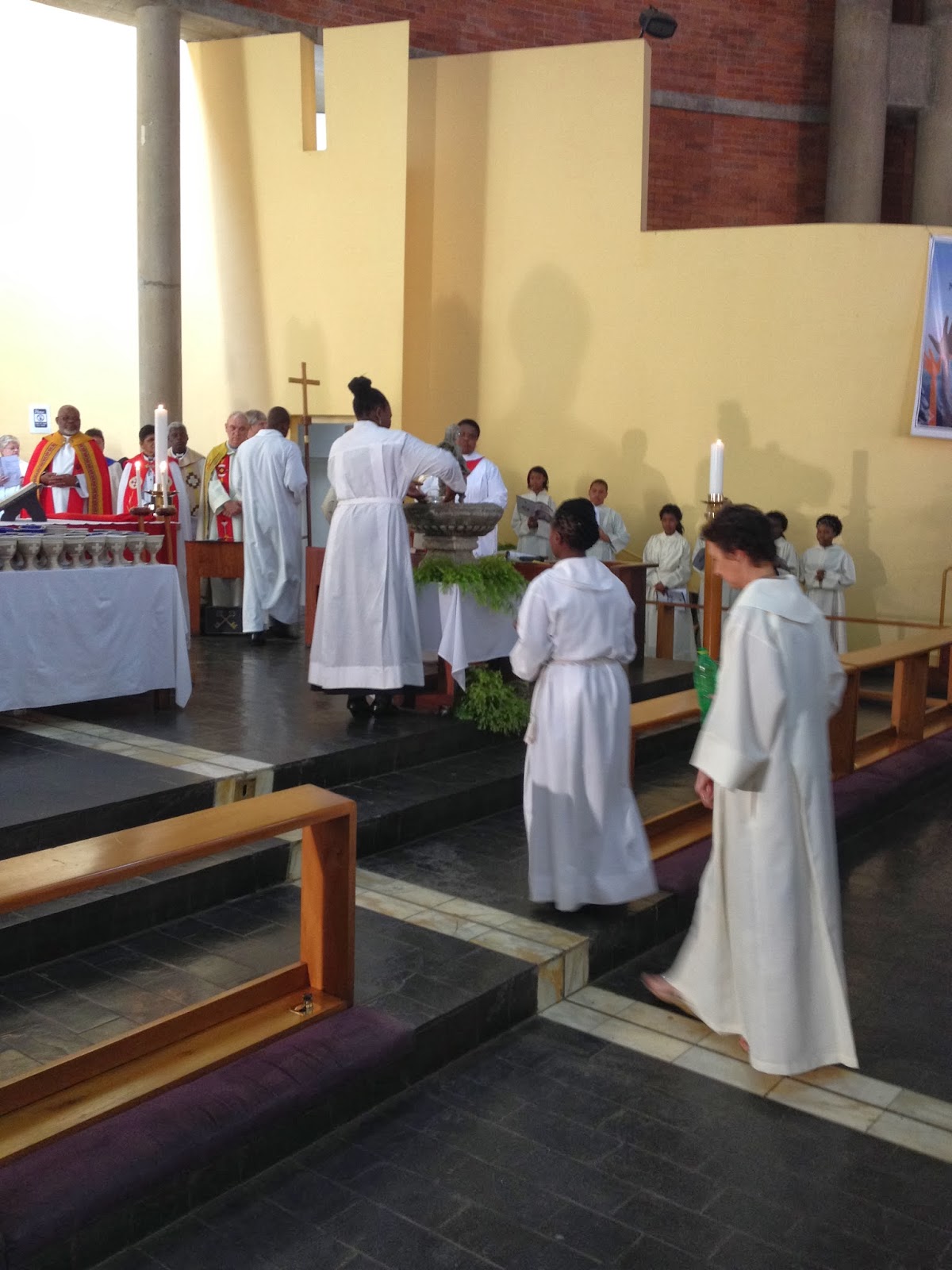
Today I took part in the celebration of the 160th Anniversary of the Diocese of Natal. I was invited by the Dean of the Cathedral of the Holy Nativity and this meant I found my place with about 50 other priests in the procession. I brought both my white and red stole. I supposed that we were to wear red but you never know. But red it was, the 30th November being the day of St. Andrew, patron saint of this diocese. In church red is the colour of the blood of the martyrs. But in Africa red is also the colour of joy!

One little question I have is why this Diocese is called the Diocese of Natal. Since 1994 the province is KwaZulu-Natal. This is something I need to ask someone about.

The celebration had the form of a high mass led by bishop Rubin and the two suffragan bishops. I just want to highlight a few things. First I want to say something about the Blessing of the Water, when lay representatives from different regions carried water from the different parts of the diocese and poured it into a font, with a fountain. It was a nice symbol. The geographical, earthly side of the Church! It was followed through in the Eucharistic prayer with the words:
In your infinite wisdom, you created earth and made it pregnant with new life. You reveal your mighty power to us in the ragged peaks of the uKhahlamba Drakensberg and in the mysterious depths of the Indian Ocean.
It was for the first time I heard geographical names in a Eucharistic Prayer. I liked it!

Second I want to mention the liturgical dance. And especially the two paradigms that met. One the one hand the hierarchical processions, where there are one cross in the front, but then another processional cross for the suffragan bishops and finally two crosses (I think they are called something else) for the diocesan bishop. When the women came dancing in the isle the body language tells something else. Still I like this kind of clashes and mixing of different symbols. It was only when bishop Rubin cracked a joke, saying that the bishops would dance later (which of course never happened) that I felt a bit sad. Had Archbishop emeritus Desmond Mpilo Tutu been there I am sure he would have joined the dancing.


Most probably the three bishops wanted to take part in the dancing.

Finally I want to say something about the sermon. It was again bishop Rubin who preached. He is maybe not the most radical of bishops but his message was good. The church needs to be a church in mission. He only mentioned one of his predecessors and that was the first bishop of the Diocese, bishop Colenso. I think I will dedicate a separate blog post to him. He was a very special person, at one stage suspended by the bishop of Cape Town, something he did not accept. (More about this later!) He was supporting the rights of black people in the 19th century and got the African name: Sobantu (mening “father of all people” in isiZulu). How fitting that I will preach in the Lutheran Church in the township called Sobantu tomorrow!

Monday, 11 March 2013

Oväntad vattensamling

På väg till gudstjänsten i söndags, tog vi den kortaste vägen till kyrkan, som ligger i stadsdelen Sobantu. Alltså inte på landet. Men vi hade glömt att vi måste passera ett vattendrag. En skylt fick oss att börja tvivla:
Bron avstängd vid översvämning.
När vi kom närmare tyckte vi nog att det såg ut som översvämning. Men vi körde på och det gick, som ni förstår, bara bra. (Fotot tog vi på hemvägen!)

Sunday, 10 March 2013

How to teach according to king David

Today we attended church in Sobantu. (When I google the word "Sobantu" I get “people friendly” and so was the congregation! We felt welcomed!)

Two students from the Lutheran Theological Institute (LTI) led the service and preached. Obviously there wasn’t any Eucharist. Still there were many ministrants. Especially for the Gospel procession.

When the congregation sang the psalm (number 32) and I read the text, it gave me some thoughts. Especially on verses 8-9 (New International Version - NIV)
I will instruct you and teach you in the way you should go; I will counsel you with my loving eye on you. Do not be like the horse or the mule, which have no understanding but must be controlled by bit and bridle or they will not come to you.
This is a kind of pedagogy I like. The teacher is clearly aware of her or his responsibility. To teach and to instruct. But the way this is done is beautifully expressed:
I will counsel you with my loving eye on you.
How often haven’t we said this? The importance of seeing one another. And the importance of being seen. Therefore the response from the disciple comes naturally. If somebody is being taught like that you do not have to be controlled like a horse or a mule. Then you go the way by yourself. You walk the way God has shown to be your way. Not somebody else’s way. Important!


In my understanding this also happened when the student introduced the tune for the singing of the psalm. The congregation followed freely. As always with different voices. He just sang the tune once and people followed. (Now I have to add that my wife, who is a soprano, felt that the tune went to high, making it difficult for the sopranos to follow, but I, being a base, enjoyed it). Never the less: the message is clear: You cannot force a person to understand. If somebody copies the leader’s behaviour, without knowing why, there is no purpose of the exercise. And of course:
Teach, counsel, and lead with your loving eye ….
It was good to see two students who really enjoyed preaching and leading the service. And we got clear evidence that the congregation also appreciated it.