Showing posts with label Nelson Rolihlahla Mandela. Show all posts

Monday, 26 September 2022

Mandela blev aldrig begravd

Det var i december år 2013 som Nelson Rolihlahla Mandela dog. Vi bodde i Sydafrika då. Det var något som påverkade hela landet och, förstod vi, hela världen. Jag bloggade en del om det då. Det går att hitta en bloggpost via denna länk. Men jag skrev ganska många bloggposter då. Vi deltog inte i den stora minneshögtiden i Johannesburg, för den dagen var vi på väg till Maputo i Mocambique. Där deltog vi dock i en minnesgudstjänst. Begravningen som ägde rum i Qunu var ju aldrig aktuellt att åka till. Den var ämnad för den närmaste familjen och särskilda gäster.

Men skrev jag inte i rubriken att Mandela aldrig blev begravd? Jo, det stämmer. Jag visste det inte förrän i lördags. Vi var på bokmässan och lyssnade till ett seminarium, som hette Kampen mot apartheid. Det var en stark uppställning personer som skulle prata om detta: Sindiwe Magona, sydafrikansk författare, Wally Serote, sydafrikansk poet, Ingrid le Roux, läkare och Mikael Wiehe, musiker, intervjuades av Marika Griehsel, journalist.

Fr v Marika Griehsel, Mikael Wiehe, Sindiwe Magona,
Wally Serote och Ingrid le Roux.

Så, vad har kampen mot apartheid med Mandelas begravning att göra. Mycket!

Sindiwe Magona berättade om att hon besökt en skola. Där hade hon pratat med klassen om att man inte använder ordet begrava om sina ledare. En ledare som dött planteras. Som när man planterar något i jorden.

(Jag tänkte på 1 Korintierbrevet kapitel 15, där Paulus använder en liknande bild. Även Jesus talar om vetekornet som måste falla i jorden och dö. En kristen kyrkogård kallas i Sverige Guds åker.)

Åter till Sindiwe Magona. Hon frågade barnen vad som kännetecknade Mandela. De svarade med ord som Mod, Klokhet, Trohet osv. Då knöt hon ihop orden med bilden. När Mandela planterades i jorden, så var det inte slut på hans liv. De egenskaper som barnen hade nämnt skulle utgöra frukter på den planta som sedan skulle komma att växa.

Sedan fick skolbarnen berätta vilken av frukterna som de menade stämde överens med deras egna förmågor. En del barn ville gärna plocka flera frukter men hon hade sagt att de fick nöja sig med en frukt var och koncentrera sig på den. Så uppmanade hon barnen att föra Mandelas arv vidare genom att själva bära någon av de frukter som de ansåg hade kännetecknat Mandela.

Så härligt det är när någon anknyter till djupt liggande kulturella föreställningar och får barnen att förstå vad det handlar om i deras egna liv. På så sätt kan kampen mot apartheid (rasism, orättvisor och förtyck) fortsätta att utkämpas. För varken Sydafrika, Sverige eller resten av världen har gjort upp med dessa orättvisor. A luta continua.

Monday, 27 December 2021

Desmond Mpilo Tutu

(A translation in English will follow).

Sedan förre ärkebiskopen för den anglikanska kyrkan i södra Afrika, Desmond Mpilo Tutu, gick ur tiden igår, har mycket redan sagts och skrivits om honom. Hans Engdahl, mångårig missionär i Sydafrika, sammanfattade det i DN igår, med orden:

Desmond Tutu var “larger than life”

Med det menar Hans att det är svårt att beskriva den stora betydelse Tutu har haft. Att ge en heltäckande bild är inte heller syftet med denna bloggpost. Men några penselstråk vill jag lägga till den stora bild som nu ges av så många.

Tutu var först och främst en del av något större. Det var på intet sätt Tutu som myntade begreppet Ubuntu men han talade ofta om denna afrikanska mentalitet. På sin fars språk, isiXhosa, skulle Tutu sagt

Umntu Ngumntu Ngabantu

Hans mamma, som var mosotho, skulle uttryckt det på ett liknande sätt:

Motho o motho ka batho

En människa är en människa bland människor. Som individ blir jag till i mötet med andra. Om inte andra finns, finns inte heller jag.

För Tutu var denna mänsklighet större än den egna gruppen. Han har beskrivit hur han fick syn på sig själv under åren i London, när han blev behandlad som en människa vid Kings college. Därför betraktade han också apartheid som ett ont system, som måste bekämpas. Att dela upp människor utifrån hudfärg var oförenligt med Tutus grundsyn.

Min egen bild av Tutu är att den världsvida kyrkan för honom var uttrycket för denna mänsklighet. Även efter sin pension 1996 ledde han regelbundet morgonmässan på fredagsmorgon i S:t Georges Cathedral i Kapstaden. Jag minns en morgon när ett filmteam var med för att fotografera och filma honom ”in action”. Någonstans skulle en staty resas över Tutu och konstnären behövde material. När fotografen blev för närgången under nattvardsbönen stannade Tutu upp och påpekade det olämpliga i att störa honom mitt i det mest centrala momentet. Fotografen backade förstås undan direkt.

Tutu var inte bara anglikan. Han var ekumen. Och det var som ledare för Sydafrikas kristna råd (South African Council of Churches – SACC) som han blev världsberömd. Han var SACC’s generalsekreterare 1978–84 och det lade grunden till att han fick Nobels fredspris 1984. Flera svenskar var direkt inblandade i nomineringen. Inte minst Axel-Ivar Berglund, som hade arbetat på SACC tillsammans med Tutu. Som generalsekreterare i SACC hade Tutu mandat att uttala sig på hela organisationens vägnar. Det fanns ett stort förtroende för Tutu och det är omöjligt att beskriva Tutu utan det sammanhanget. Men även här var hans kristna tro grunden. Han införde daglig morgonbön, regelbundet mässfirande och retreat för de anställda. Den kristna tron och engagemanget för rättvisa var två sidor av samma mynt. Oupplösligt förenade. Under alla år har Tutu börjat sin dag med egen meditation och bön. Utan den stunden hade han inte kunnat åstadkomma något, enligt egen utsago.

När jag läser artiklar, tweets och olika uttalanden är det ofta som Tutus förankring i sin gudstro glöms bort. Därför är det bra att exempelvis Svenska kyrkans ärkebiskop, Antje Jackelén, säger i DN:

För det var det som var Desmond Tutus livsmelodi – att leva sin tro i kärlek till människor.

Hans husläkare, Ingrid le Roux, säger också till Kyrkans Tidning:

Men han är också en djupt troende och andlig människa. Han lever nära korset, med bön och meditation varje dag. Det är hans styrka, det som burit honom.

Där fanns också skälet, tror jag, till att Nelson Rolihlahla Mandela utsåg honom till ledare för Sannings- och försoningskommissionen 1995. Desmond Tutus uppdrag var på intet sätt slutfört när Sydafrika fick sin första demokratiskt valda president. Kommissionen lyckades vidga ett från början kristet begrepp till att gälla samhället i stort. Som ordförande uppträdde Tutu alltid i sin biskopsdräkt.

Samtidigt fortsatte han att vara en profetisk röst även efter demokratiseringen. Han kunde exempelvis hota Zumas regering med att kristna skulle be för den regeringens fall, på samma sätt som kristna bad under apartheid, om inte regeringen ändrade sin politik. Hans kritik mot korruptionen var svidande. De fattiga var alltid i fokus.

Tutu är en stor inspirationskälla. Må han vila i frid till uppståndelsens morgon.

---


Since the former archbishop of the Anglican Church in southern Africa, Desmond Mpilo Tutu, passed on yesterday, much has already been said and written about him. Hans Engdahl, a longtime missionary in South Africa, summed it up in DN yesterday, with the words:

Desmond Tutu was "larger than life"

By that, Hans means that it is difficult to describe the great importance Tutu has had. Providing a comprehensive picture is not the purpose of this blog post either. But a few brushstrokes I want to add to the big picture that is now given by so many.

Tutu was first and foremost a part of something bigger. It was by no means Tutu who coined the term Ubuntu but he often talked about this African mentality. In his father's language, isiXhosa, Tutu would say

Umntu Ngumntu Ngabantu

His mother, who was a Mosotho, would put it this way:

Motho o motho ka batho

A person is a person among persons. As an individual, I am created in the interaction with others. Unless others exist, neither do I.

For Tutu, this humanity was larger than the own group. He has described how he saw himself over the years in London, when he was treated like a human being at King's College. Therefore, he also regarded apartheid as an evil system, which must be fought. Dividing people by skin colour was incompatible with Tutu's basic view.

My own image of Tutu is that for him the worldwide church was the expression of this humanity. Even after his retirement in 1996, he regularly led the morning mass on Friday morning in St. George's Cathedral in Cape Town. I remember one morning when a film team was there to take photos and film him "in action". Somewhere a statue was to be erected over Tutu and the artist needed materials. When the photographer became too close during the communion prayer, Tutu stopped and pointed out the inappropriateness of disturbing him in the middle of the most central moment. Of course, the photographer backed away immediately.

Tutu was not just Anglican. He was ecumenical. And it was as the leader of the South African Council of Churches (SACC) that he became world famous. He was SACC's Secretary General in 1978–84 and this laid the foundation for him to receive the Nobel Peace Prize in 1984. Several Swedes were directly involved in the nomination. Not least Dr Axel-Ivar Dabulamanzi Berglund, who had worked at SACC together with Tutu. As Secretary General of the SACC, Tutu had a mandate to speak on behalf of the entire organization. There was a great deal of trust in Tutu and it is impossible to describe Tutu without that context. But even here his Christian faith was the foundation in a very practical way. He introduced daily morning prayer, regular Mass celebrations and retreats for the employees. The Christian faith and the commitment to justice were two sides of the same coin. Inextricably linked. Throughout the years, Tutu has begun the day with own meditation and prayer. Without that moment, he would not have been able to achieve anything, according to his own statement.

When I read articles, tweets and various statements, it is often that Tutu's anchoring in his faith in God is forgotten. Therefore, it is good that, for example, the Archbishop of the Church of Sweden, Antje Jackelén, says in DN:

Because that was what Desmond Tutu's life melody was - living his faith in love with people.

His family doctor, Ingrid le Roux, also tells Kyrkans Tidning:

But he is also a deeply believing and spiritual man. He lives near the cross, with prayer and meditation every day. It is his strength, what has carried him.

There was also the reason, I think, that Nelson Rolihlahla Mandela appointed him head of the Truth and Reconciliation Commission in 1995. Desmond Tutu's mission was by no means complete when South Africa got its first democratically elected president. The Commission succeeded in extending an initially Christian concept to society as a whole. As chairman, Tutu always appeared in his bishop's robe.

At the same time, he continued to be a prophetic voice even after democratization. He could, for example, threaten the Zuma government with Christians praying for the fall of that government, in the same way that Christians prayed under apartheid, unless the government changed its policy. His criticism of corruption was scathing. The poor were always in focus.

Tutu is a great source of inspiration. May he rest in peace until the morning of the resurrection.

Wednesday, 16 December 2020

The struggle against corruption

16 December is a Public Holiday in South Africa. It is the Day of Reconciliation. The reasons are numerous. The South African Truth and Reconciliation Commission held its first meeting on 16 December 1995. Before that Umkhonto we Sizwe ("Spear of the Nation" or MK), the armed wing of the ANC, began its first campaign on 16 December 1961. Afrikaners used to commemorate 16 December as the Day of the Vow also known as Day of the Covenant.  This has to do with the Voortrekker victory over the Zulus at the Battle of Blood River in 1838. But today it is the Day of Reconciliation.

I would like to dedicate this blog post to one of our family’s dear friends, Mr Sekhopi Malebo. I met him in Sweden in 1981 before I left for South Africa, where I worked in the Evangelical Lutheran Church in Southern Africa (ELCSA) for one year. Sekhopi belongs to the very same church. He spent the same period in Sweden and coincidentally he attended the same training as my wife. That was in a folk high school and they studied pedagogy and Christian education.

When Sekhopi returned to South Africa he got even more involved in the struggle against apartheid. He was involved in the Constitution Assembly that led to the Constitution of the New Democratic South Africa. He became a member of parliament after 1994 and after that a Minister in the Free State. 

When we moved to South Africa in 2002 with our family, we lived in Bloemfontein, Mangaung, where Sekhopi and his family also lived. Our children were schooling together. We belonged to the same Lutheran Congregation in Batho. Many times, we have underscored how much the whole Malebo family meant to us during those years. Sekhopi is involved in the leadership of ELCSA both on Congregational, Diocesan and Church wide level.

You don’t find many photos of Sekhopi on the web, but this I borrow from the Evangelical-Lutheran Church in Northern Germany. They also provide a good summary of who Sekhopi is. You find the link here.

Sekhopi is a person who carries the legacy after Nelson Rolihlahla Mandela. Right now, he is involved in a new struggle to fight the phenomenon named state capture. He is one of the organisers of a march to ANC headquarters at Luthuli House that took place some time ago. Mail and Guardian states that one person that is targeted is the Secretary General of the ANC, former Premier of the Free State, Ace Magashule. 

A few days ago Ace Magashule appeared before the ANC Integrity Commission. Magashule is facing 21 charges of corruption, fraud and money laundering from his time serving as Free State premier.

My wife and I cannot do much to support this struggle. But this is one way. We also keep Sekhopi and his family in our prayers as we understand that his part in this is pivotal. South Africa is our second home country. We really wish the rainbow people a just sharing of the wealth that this rich country has.

I know that we are many in Sweden who support this struggle in the same way as we supported the fight against apartheid. And I also know that there are many South Africans who wants this fight to succeed.


Saturday, 17 February 2018

Thuma mina, sings Lutheran Ramaphosa

On Thursday 15 February Matamela Cyril Ramaphosa was sworn in as President of the Republic of South Africa. He succeeded Jacob Gedleyihlekisa Zuma, according to Al-Jazeera an embattled ex-leader.

In my understanding this is good for South Africa. But one should not be to optimistic. Compared with Zuma, Ramaphosa is a much better leader. That is my deep conviction. But he is still a tainted leader. He was one of the owners of the Lonmin mine, where the Marikana massacre took place 16 August 2012. 17 mine workers were killed. Shot by the police.

Ramaphosa is also a very rich person. This could be an asset. He does not need corruption. He already has enough. At the same time he is distant from the poor and marginalized.

Ramaphosa talar vid en begravning i en luthersk kyrka.
Having said that I must confess that I appreciate his leadership style. One reason for that could be that he originates from the Evangelical Lutheran Church of Southern Africa (ELCSA) the very church that my own Church, Church of Sweden (CoS) has been in partnership with for more than a century. According to the Limpopo Mirror he
… grew up under strict Christian supervision as his mother was a staunch member of the Lutheran Church.
I am not sure whether or not he himself belongs or has belonged to ELCSA. Be that as it may, I guess that I somehow connect with him.

I have read his State of Nation Address (SONA). Much of it is of course normal rhetoric. It is interesting though, that he speaks firmly about land expropriation without compensation:
Guided by the resolutions of the 54th National Conference of the governing party, this approach will include the expropriation of land without compensation.
We are determined that expropriation without compensation should be implemented in a way that increases agricultural production, improves food security and ensure that the land is returned to those from whom it was taken under colonialism and apartheid.
This clear message was sandwiched in between reconciling words. He started by stating that the year to come will be a commemoration of Nelson Rolihlahla Mandela’s centenary. He was born in 1918. Ramaphose said:
Guided by his example, we will use this year to reinforce our commitment to ethical behaviour and ethical leadership.
Another icon was also born the same year:
Albertina Nontsikelelo Sisulu
Ramaphosa continued:
We honour this son and this daughter of the African soil in a year of change, in a year of renewal, in a year of hope.
On twitter I have seen many examples that people found hope in the speech. One tweet comments this in a very ironic way:

He spoke openly about how poverty levels have risen in 2015, how unemployment has gone up and how inequality has persisted. He also admitted that the that economy has not grown for several years. 
Of course he also spent time talking about the role of education, investment and job creation. The latter especially with the youth in focus.

An interesting thing was the announcement that the Government will introduce the first national minimum wage in South Africa in 1 of May. He also announced that
… free higher education and training will be available to first year students from households with a gross combined annual income of up to R350 000.
He also mentioned a continuing fight against HIV where the goal is set:
This year, we will take the next critical steps to eliminate HIV from our midst.
The opposition will monitor how these promises are kept. On Times Live I heard Julius Malema talk about this. The EFF will hold Ramaphosa accountable, said Malema. They gave him a chance to deliver his speech. Malema said they (EFF) want peace in the parliament.

Most interesting will be how Ramaphosa deals with his predecessor, Zuma. Will he (and the state institutions) hold him accountable? That is still to be seen. Ramaphosa said:
This is the year in which we will turn the tide of corruption in our public institutions.
The criminal justice institutions have been taking initiatives that will enable us to deal effectively with corruption.
I hope that justice really will prevail.

Ramaphosa concluded by citing a well-known South African musician, Hugh Masekela. The song is called: Thuma mina.
I wanna be there when the people start to turn it aroundWhen they triumph over poverty
I wanna be there when the people win the battle against AIDS
I wanna lend a hand
I wanna be there for the alcoholic
I wanna be there for the drug addict
I wanna be there for the victims of violence and abuse
I wanna lend a hand
Send me.
'Send me' in isiXhosa and isiZulu is 'Thuma mina'. This is the watch word of the Lutheran Youth League in ELCSA. Was this song chosen by coincidence? 

Wednesday, 8 July 2015

Constitution Hill

The hospital section at the Old Fort.

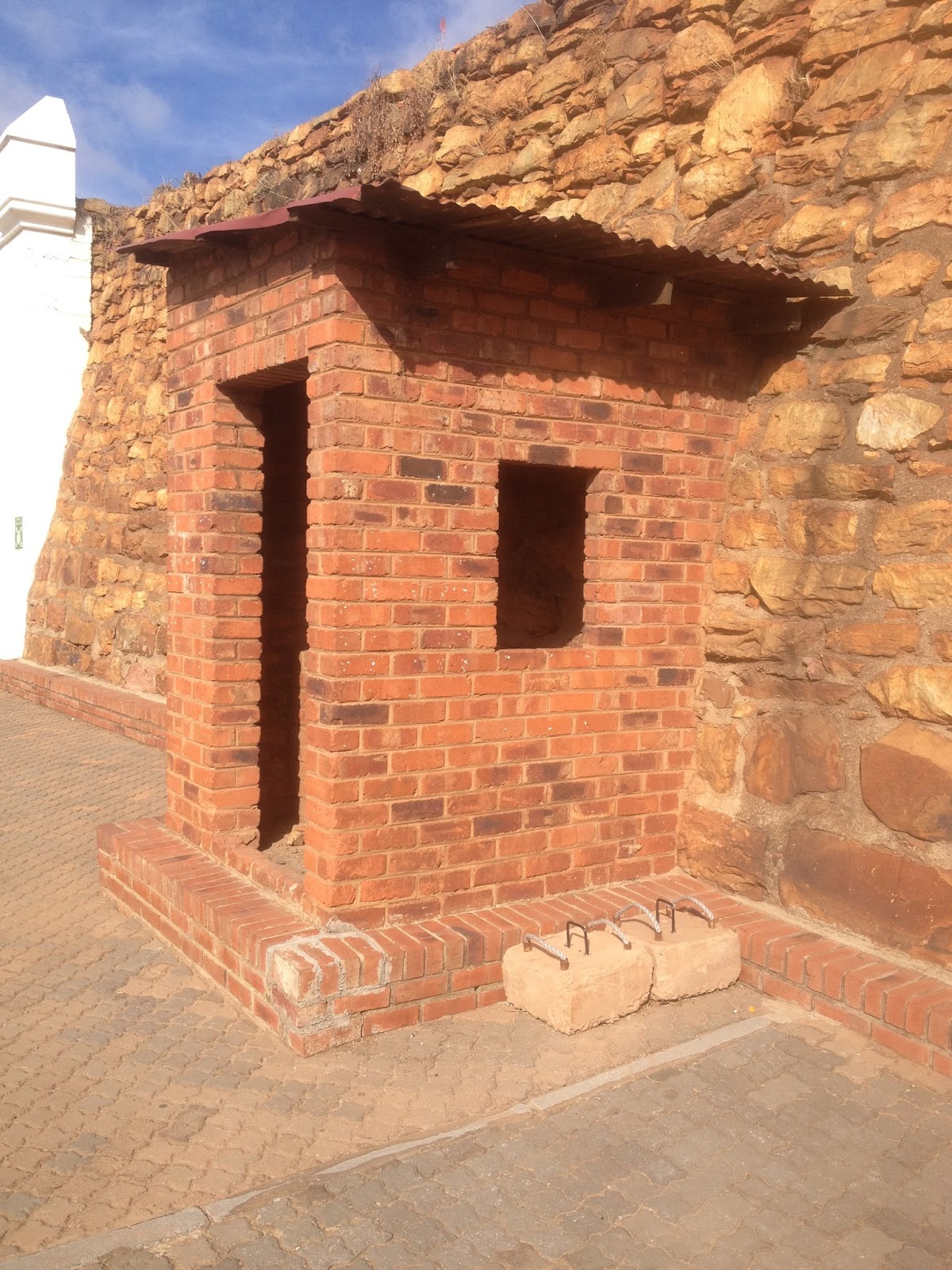
For the first time we visited Constitution Hill today. The old fort, where Nelson Rolihlahla Mandela was an awaiting-trial prisoner in 1962. This was before the Rivonia Trial. He was kept in the hospital section, in the Old Fort itself. The Fort was for white prisoners only. As far as I understand Mandela was not sick. This was a way to keep him away from the other black prisoners.

Today The Constitutional Court of South Africa has its location on Constitution Hill. We did not take the guided tour but we were able to see some of the buildings. We also saw photos of three South Africans that we know. Of course Judge Edwin Cameron, one of the judges in the Constitutional Court.

We have met Judge Edwin Cameron several times. A role model.
We were more surprised to see Paul Mokgethi-Heath and JP Mokgethi-Heath on a poster. Impressive, I must say. There were a number of posters illustrating different kinds of human rights issues that the Constitutional Court in South Africa had ruled on. Same sex rights being one of them.
Examples of human rights.
JP is one of our colleagues at the Church of Sweden international department.


Sunday, 22 February 2015

Today's sermon

Service in the Anglican Cathedral of the Holy Nativity
first Sunday in Lent 22 February 2015 at 7 and 8.30
Texts: Genesis 9:8-17, Psalm 25:1-10, 1 Peter 3:18-22, Mark 1:9-15
Your bow in the clouds proclaims your covenant …
A bow - the rainbow - a rainbow nation!

The first reading, from Genesis 9:8-17 is part of a biblical narrative that so many people in the history of humankind, have identified with.

We see the rainbow as a symbol for many things.
  • South Africa, a rainbow nation
  • The Gay and Lesbian community uses a rainbow flag
  • Greenpeace had a boat called rainbow warrior, sunk by the French intelligence service in 1985 in Auckland, New Zealand.
  • A Swedish Rema Church has it in its logotype.
We all love the rainbow. It reminds us of the covenant.

But the narrative is problematic.

It says:
… never again shall there be a flood to destroy the earth …
Say that to the people of Malawi and Mozambique some months ago …

Never again …

It reminds me of the speech that Nelson Rolihlahla Mandela held at his inauguration as President of South Africa in Pretoria 10 May 1994:
Never, never and never again shall it be that this beautiful land will again experience the oppression of one by another and suffer the indignity of being the skunk of the world.
How about today? With xenophobia and corruption?

But there are also other problems. The narrative speaks about a covenant. We know how this concept has been used and abused.

The covenant that God made with the Afrikaner people at the battle at Blood River or Ncome river. 16 December 1838.

And if we continue to read in Genesis 9 we get the story of Noah drinking wine and getting drunk, which results in him taking of all his clothes and falling asleep in his tent. One of his sons, Ham, sees him naked (a taboo) and a curse is cast on the grandson, Canaan:

Noah wakes up and says:
Blessed by the Lord my God be Shem; and let Canaan be his slave.
May God make space for Japheth, and let him live in the tents of Shem; and let Canaan be his slave.
These verses were used by the apartheid theologians as a way to explain why black people should serve white people.

Isn’t it strange how we make use of the biblical text, the word of God, to further our own privileges?

Let’s go to the Epistle text where we learn about the New Covenant through Christ. Peter writes about
… the days of Noah, during the building of the ark, in which a few, that is, eight persons, were saved through water. And baptism, which this prefigured, now saves you—not as a removal of dirt from the body, but as an appeal to God for a good conscience, through the resurrection of Jesus Christ.
But even in this context, in the beginning of the same chapter, Peter writes about how wives must accept the authority of the husbands. He describes women as the weaker sex.

Haven't these verses been used for oppression? Although Peter also says that husbands must show consideration for their wives. A verse we men often forget to read.

Always those contending voices in the bible; oppression and slavery side by side with liberation and salvation!

It is not strange. Even in Jesus’ own life here on earth there was a spiritual war. A fight between powers! The middle section of the Gospel tells us what happened directly after Jesus’ baptism and reads like this:

And the Spirit immediately drove him out into the wilderness. He was in the wilderness forty days, tempted by Satan; and he was with the wild beasts; and the angels waited on him.

These were the different characters in the drama:
  • Jesus
  • The Spirit
  • Satan
  • Wild beasts
  • Angels
Of course the Biblical narrative is influenced by the evil power in the same way.

But the Word of God – which is Jesus Christ – is there. In the middle of the Bible and in the Church!

When we enter this time of lent we do it with an objective to live close to Jesus; to walk beside Jesus or allow Jesus to walk next to us.

We need to revisit the Bible, as in the Lent Course, every Wednesday up to Easter.

We need to engage with one another in the congregation. Yes, we may and we should read the Bible on our own but even more, we should do it together.

We should also allow the Holy Spirit to guide us, when we share the bible.

So that we may understand, on a deep level, that we really are in a covenant with God. A covenant which is not there only for our sake! We should not forget others.

It is a covenant that God made with us and
… every living creature that is with you, for all future generations
There can be no oppression. We are in this together.

Let us digest this during lent. Let us pray to God, that we become Christ-like in loving the whole world, just as God loves the whole world.

There will be other forces in our lives. Trying to distract us, trying to draw us away from what is right.

Let us therefore also see lent as a time to live closer to Jesus in this sense, asking for his grace and forgiveness.

It is only in him and through him we can achieve this.


Friday, 5 December 2014

Mandela

Flowers in front of the monument a year ago.
Idag för ett år sedan dog Nelson Rolihlahla Mandela. Låt oss ägna en minut åt eftertanke. Inte minst med tanke på situationen i Sverige. En fråga kunde vara:
Hur skulle Mandela ha tänkt kring situationen i Sverige idag?
Självklart kan varken jag eller någon annan ge ett svar på detta. Vad jag i stället vill göra är att använda Mandelas liv som ett teoretiskt ramverk, för att se på den uppkomna situationen i Sveriges riksdag (som jag menar är ett symptom på djupare problem i det svenska samhället.)


Inte långt från Pietermaritzburg finns ett monument över Mandela som verkligen är värt ett besök. Det har rests på den plats där Mandela greps den 5 augusti 1962.

I det lilla museet, som finns på platsen, sammanfattas Mandelas liv med sex ord:

Character - personlighet
Comrade - kamrat
Leader - ledare
Prisoner - fånge
Negotiatior - förhandlare
Statesman - statsman [sic]
Character - personlighet
Vi har alla fått olika gåvor. Vi är personligheter. Låt oss använda dessa och tacka Gud för dessa. Det gäller inte bara människor, som vi beskriver som goda. Även personer som hyser uppfattningar, som vi inte delar, har fått en personlighet, som använd på rätt sätt, kan vara gemenskapen till nytta.

Comrade - kamrat
Mandela var medlem av ANC. Det var under hela hans liv oerhört viktigt. Om vi ska kunna arbeta för ett gott samhälle, måste vi organisera oss. Rimligen gör vi det i olika organisationer. Det är bra. Men alla organisationer, menar jag, kommer inte att kunna skapa ett gott samhälle, för de har som grundidé att samhället bara är till för vissa.

De så kallade Sverigedemokraterna är en av dessa organisationer. I deras valmanifest står det:
Sverigedemokraterna arbetar för ett Sverige där samhället präglas av en historiskt rotad, gemensam svensk kultur som skapar sammanhållning och solidaritet mellan medborgarna.
Vad skulle Mandela sagt? Jag tror att han skulle skakat på huvudet och tänkt att på denna grund kan aldrig ett samhälle byggas.

Leader - ledare
Ska vi på allvar kunna motverka den ideologi som de så kallade Sverigedemokraterna står för, behövs ledare. Inte först och fraämst ledare som är ’emot’ utan ledare ’för’. Ledare för ett gott samhälle. Sådan ledare finns. Men finns det någon som idag kliver fram i Sverige? Någon som sticker ut? Kanske skulle Tage Danielsson eller Astrid Lindgren, om de levt, kunnat vara sådana ledare.

Eller är det precis tvärtom. Vi kan alla ta vår egen ledarroll på allvar. Mandela blev inte världsberömd på en gång. Det viktiga ledarskapet ägde rum långt innan han nådde ära och berömmelse. Många andra ledare i Sydafrika spelade en lika avgörande roll som Mandela – men blev inte berömda. Ditt och mitt ledarskap kan vara avgörande.

Prisoner - fånge
Kampen för det goda samhället har alltid ett pris. Kanske inte fängelse. Men det är obekvämt att stå upp för mänskliga rättigheter. Även i Sverige. Ville Mandela spendera 27 år i fängelse? Säkert inte! Men han var beredd att göra det, när det krävdes. Vad är Du och jag beredda att offra, ge upp, för ett gott samhälle?

Negotiator - förhandlare
Som jag ser det, är det helt fel att i nuläget förhandla med de så kallade Sverigedemokraterna. De ledamöter i riksdagen som vägrar detta gör rätt. När Mandela (och andra frihetskämpar) kämpade mot Apartheid, fanns det inte på kartan att förhandla med de styrande, som gjorde skillnad på människor, utifrån ras. Men när apartheidregimen höll på att falla, då var det dags för försononing och förhandling.

De så kallade Sverigedemokraterna har idag ingen reell makt i Sveriges riksdag,  om inte de andra partierna ger det till dem. Min uppfattning är att alla de andra sju partierna har del i den uppkomna situationen. Och även del i lösningen. De måste förhandla med varandra.

Statesman – statsman [sic]
Min bön och förhoppning är att den som får talmannens [sic] förtroende att bilda regering efter det extra val som ska hållas i mars nästa år, kliver fram som en ansvarskännande statsperson. Och att de andra i riksdagen också agerar så.

Vid monumentet utanför Pietermaritzburg går det att läsa något som Mandela har sagt:
It always seems impossible until it's done.
Det ser alltid omöjligt ut tills det är gjort.
Det önskar jag att vi i Sverige skulle ta till oss. Det går att bygga ett gott samhälle. Där målsättningen är att alla medborgare får del av det goda. Ett samhälle som också är öppet för att ta emot dem som söker skydd. Eftersom ytterst hela jorden är ett, enda samhälle.

Monday, 16 December 2013

Vad är egentligen försoning?

Dessa dagar, när Nelson Rolihlahla Mandela – även kallad Madiba eller Tata – har gått ur tiden förekommer ordet försoning i många sammanhang. Reconciliation. Det är nu inte min avsikt att skriva en uttömmande text om detta begrepp. Det lämpar sig inte för en bloggpost. Jag väljer också att just i detta sammanhang avstå att diskutera försoningsbegreppet ur ett uttalat teologisktperspektiv. För begreppet har ju lånats från kyrkan och kommit till användning i ett politiskt sammanhang. Visst hänger det ihop men nu vill jag se på det från ett allmänmänskligt perspektiv.

När jag funderar över försoning bygger jag på vad andra tänkt. Dels det så kallade Kairosdokumentet. Dels en teolog som heter Charles Villa-Vicencio. Låt mig börja med Kairosdokumentet, som publicerades av teologer i Sydafrika 1985. Dokumentet beskriver tre olika samtida teologier. State Theology (som jag inte kommer att skriva om) Church Theology och Prophetic Theology (som jag inte heller kommer att kommentera här). Typiskt för Church Theology är att den sopar konflikter under mattan, för att den vill ha frid/fred. Talet om försoning blir i detta sammanhang kontraproduktivt. Följande citat beskriver vad det handlar om:
In our situation in South Africa today it would be totally unChristian to plead for reconciliation and peace before the present injustices have been removed. Any such plea plays into the hands of the oppressor by trying to persuade those of us who are oppressed to accept our oppression and to become reconciled to the intolerable crimes that are committed against us. That is not Christian reconciliation, it is sin.
Detta är viktigt att komma ihåg. Det finns ofta ett maktperspektiv med, när vi pratar om försoning.

När Mandela släpptes efter 27 års fångenskap hade han förtjänat ett enormt förtroendekapital. Han hade därmed ett slags moraliskt grundat tolkningsföreträde när det gällde vem han kunde sträcka ut handen till. Mandela valde som president en ”open door policy”. Hans meningsmotståndare och forna fiender hade direkt tillträde till honom. Han valde ofta att själv servera dem te när de träffades. Säkert var de inte överens men han valde själv att tjäna sin medmänniska, även sin motståndare. Och det var ett fritt val. Jag menar att det verkligen fanns något Kristuslikt i detta.

Så till min andra inspiration. Charles Villa-Vicencio lyssnade jag till i Uppsala 2002. Han beskrev då ett annorlunda sätt att se på försoning. Vanligtvis tänker vi oss att det börjar med en slags ånger över det som blivit fel. Sedan ber den felande parten om förlåtelse. Den förorättade förlåter därefter. När detta har skett inträder ett tillstånd som vi kallar försoning. Schemat blir: Brott – ånger – bön om förlåtelse – tillsägelse om förlåtelse – försoning. Och det är klart att det också kan gå till så ibland. Kanske oftast! Men inte alltid!

Så Charles Villa-Vicencio vänder på det. Eller snarare: han menar att försoning är en process i stället för en slutprodukt. Denna process kan börja med att man räcker ut en hand, delar en måltid, vågar finnas i samma rum.

Det är återigen viktigt att tänka in maktperspektivet. En försoningsprocess mellan två jämbördiga parter måste bli annorlunda än mellan en förtyckare och den som förtrycks. Och det måste alltid, menar jag, vara den som är i den utsatta positionen som har tolkningsföreträde.

Men jag tror att försoning alltid är en nödvändighet. Processen kan se väldigt olika ut. Det kan ta tid och krävas öppen konflikt innan vi ens vågar ta de första stapplande stegen. Men för mig är frågan om det finns något alternativ? Ja, det skulle i så fall vara fortsatt öppen konflikt. Kanske i form av en bestående brytning eller avståndstagande. Åtskillnad! Apartheid!

Men vill vi detta? Vare sig vi tänker på samhället, kyrkan eller familjen (hur den nu ser ut) kan jag inte se någon annan väg än försoning.

Andra inspirationskällor är naturligtvis Women in Church and Society (Kyrkornas Världsråd), kommuniteten i Taizé och Institute for Healing of Memories i Sydafrika. På olika sätt arbetas det här med försoning mellan olika parter.

Idag är det helgdag i Sydafrika: försoningsdagen. Den finns många historiskt betingade bottnar i landet denna dag. Det kan verka som en tillfällighet att den 10 dagar långa sorgeperioden efter Mandela följs av den nationella försoningsdagen. Men jag tror inte det är en slump. Jag tror det är en stark uppmaning till var och en, som mediterat över Mandelas liv dessa dagar, att nu göra sitt eget liv till en försoningsprocess. Kontextuellt. Frivilligt. På den punkt i livsresan var och en själv befinner sig. Men med målet i sikte.

Friday, 6 December 2013

Madiba

Inevitably this day had to come. Every human being has to die. Even Madiba. Nelson Rolihlahla Mandela. Still it feels strange. Mandela is a person who at one stage by some were described as a terrorist and by others as a hero, who during his own lifetime became a legend. In South Africa a number of streets, roads and even a municipality are named after him.

Lots of people in South Africa have looked upon him as a guarantee for stability and democracy in the country. This is of course understandable. His personal journey has to fill every person on this earth with respect. For many years though, Mandela had left the official scene, before his death. The stability in South Africa is something that many South Africans can be proud of. There are of course many corrupt politicians and state officials. There are likewise criminals, greedy businessmen/women and lots of just ordinary persons who make wrong decisions. But there is also another picture. After almost two decades South Africa is functioning. Of course with too much poverty and injustices. But still, we haven’t seen civil war or massacres. The president, Jacob Zuma, has managed better with HIV and AIDS then his predecessor. So even this day, or especially this day, we need to reflect on whether it is true or not that the stability in South Africa depends on whether or not Mandela is alive. Instead of living with Mandela we now have to live only with his legacy. My interpretation, living in South Africa for the third time, is that South Africans in general admire Mandela because they subscribe to his values. They seek reconciliation although it is difficult or even non-achievable.

This day the best way of paying tribute to a legend who has lived an impressive life is to live according to his ideals:
If there are dreams about a beautiful South Africa, there are also roads that lead to their goal. Two of these roads could be named Goodness and Forgiveness.
So, the message is this: every South African now needs to carry the values of Mandela in her/his own body. If everyone carries a little bit, a new miracle is possible.


My wife took the picture when Mandela handed over the keys to the first persons 
who moved back to District 6 in Cape Town in February 2005.

Thursday, 27 June 2013

Zuma cancels Mozambique trip


Clearly the issue of seriousness has been such that President Jacob Zuma has cancelled his trip
says the presidential spokesperson, Mac Maharaj, in Talk Radio 702, according to Mail and Guardian
about the former president Nelson Rolihlahla Mandela.

The deterioration in Mandelas health from "serious but stable" to "critical" seems to have caused a switch in the mood of the South African nation, from prayers for recovery to preparations for farewell.
One who is preparing and praying is the AnglicanArchbishop Thabo Makgoba:
And may your blessing rest upon Madiba now and always. Grant him, we pray, a quiet night and a peaceful, perfect, end.


Monday, 10 June 2013

South Africa is preparing itself ….

Nelson Rolihlahla Mandela. Madiba. He is back in hospital. South Africa is praying. So does the rest of the world. But today the reporter asked, in e-news:
Praying for what?
She said that some pray for his recovery while others believe that the time might have come for South Africa to let go of the icon. The reporter referred to social media and I can see for myself that people are confused. Mail and Guardian reports that
Madiba became the latest victim of a death hoax on Twitter after a fake Piers Morgan account tweeted that the former president had died in his sleep.
So unnecessary! In my own face book flow I catch this status update, which I liked:


While president Zuma has urged the nation and the world to pray (which I also like) one person interviewed in e-news said that it would be terrible if Mandela died now. But then he added that we cannot interfere with God’s will.


South Africa is preparing itself …

Wednesday, 1 May 2013

Nelson Rolihlahla Mandela – ett slagträ

Hur kunde det bli så här? Madiba – en levande legend. Han kallas för en ikon. Över hela världen möts hans namn av respekt. Men i Sydafrika har Mandela, i slutfasen av sitt liv, blivit ett slagträ i ett ganska otrevligt, politiskt, taktiskt spel.

För några dagar sedan besökte en ANC-delegation, med president Jacob Zuma i täten, den åldrande ex-presidenten i dennes hem i Houghton, utanför Johannesburg. Detta besök fick förstås mycket mediatid. Därefter går meningarna isär.

Kritikerna kallar det för ett media-stunt. Besöket utlöste en twitter-storm med kommentarer av olika slag. Ett exempel, som återges i Mail and Guardian:
Who's the idiot who took a picture of Madiba with flash during the visit by ANC officials? Don't they know it hurts his eyes?!
Människor upplever (och jag håller helt med) att Mandela enbart verkar plågad av besöket.

ANC svara på sin hemsida att besöket var ett uttryck för Ubuntu*. ANC slår helt ifrån sig den kritik, som hörs i Sydafrika över besöket.

Så döm själv. Hur verkar Mandela må? Känns det som om han gillar situationen? Länken kommer här.

Mpho Moshe Matheolane skriver en krönika under rubriken:
The travesty of Madiba as a gimmick
i Mail and Guardian, som tycker summerar ganska väl det som händer kring Mandela i Sydafrika idag. Jag återger det sista stycket:
Our dearest icon, upon who South Africans have placed their hopes, is in the last scene of this stage-act we call life. Although not a victim of oblivion[**], and arguably unlikely to ever be such, he has done his part. The ANC, the world and more specifically South Africans, would do well to learn to not only accept that but to prepare to live without him as well. Maybe in this way, he can actually have the peace that he needs while he still has life to live.

* Ubuntu = ett filosofiskt begrepp som uttrycker medmänsklighet och samhällsgemenskap i södra Afrika
** victim of oblivion = bortglömd

Friday, 6 January 2012

ANC 100 år

När vi bodde i Sydafrika lärde vi känna en ung man, Fikile. Han är nu pastor i ett samfund, som jag inte riktigt vet vad det heter. Karismatiskt är det nog. Såhär skriver han på en FB-sida, som heter ”Get your shine on”. Sidan har över 400 medlemmar:
Kingdom greetings my brothers and sisters.
Kindly pray with South Africa as there will be an ANCESTORAL dedication of the country that will be done today. We sure want Theocracy in our country and not Demon-Crisis. As we well know, the African National Congress [ANC] was founded by pastors, but they went astray as years rolled. This ceremony that will be held today in Bloemfontein has to be rendered null and void by children of God. Make declarations against these evil forces that our government are is bringing into our country. Job 22:28, Matthew 18:18.
ANC firar 100-årsjubileum. Det börjar ikväll och pågår i tre dagar. I Bloemfontein, där vi bodde i 4 år. Det var just i Bloemfontein ANC bildades. 1912. Av bl a pastorer, som Fikile skriver. På ANC’s hemsida kan man också läsa om den bön, som kommer att äga rum. I en kyrka, eftersom ANC bildades just i denna kyrka eller i närheten.
18h00 Waaihoek, Wesleyan Church, the founding place of the ANC Night Vigil by CRATA and NICSA.
7th January 2012
05h45 Waaihoek Wesleyan Church, the founding place of the ANC, Cleansing and Restoration. This Ceremony takes place at the Marquee at Waaihoek.
Vi förstår begreppen ”Night vigil”, Cleansing and Restoration” som begrepp med anknytning just till den traditionella religiositet, som är just förknippad med förfädersandarna. Så långt har nog Fikile rätt. Men frågan är: är det oförenligt med kristen tro? Kyrkorna i Sydafrika svarar helt olika på den frågan. De karismatiska, pentekostala och evangelikala säger blankt nej. Traditionella kyrkor som lutheraner, anglikaner och metodister erkänner inte förfäderna i sina gudstjänster men alla vet att förfäderna vördas. Om det ska vara dop en söndag sker en traditionell ceremoni lördag morgon. Många kristna deltar. Men man skiljer på det som gäller förfäderna och det som gäller i kyrkan. Katolska kyrkan kan däremot väva in förfäderna i sin vanliga liturgi. Som en del av gudstjänsten.
CRATA utläses: The Commission for Religious and Traditional Affairs och NICSA betyder National Interfaith Council of South Africa. Det ska bli intressant att höra vilka kristna som är med på ceremonierna och på vilket sätt. NICSA är ett organ, som ANC tagit initiativ till. Förre presedenten, Mbeki, relaterade till ett annat råd, som hette National Religious Leaders Forum (NRLF). Sedan startade Zuma ett annat råd: National Interfaith Leadership Council (NILC).
I ett ANC-uttalande gjort av Mathole Motshekga, ledamot i ANC national executive council, läser jag:
The ANC Commission on Religious and Traditional Affairs (CRATA) has given effect to the Polokwane resolution on interfaith work. It has facilitated the dissolution of the National Religious Leaders Forum (NRLF) and the National Interfaith Leaders Council (NILC) and the formation of the National Interfaith Council of South Africa (NICSA) and its affiliation to the National Interfaith movement to the Interfaith Action for Peace in Africa (IFAPA). National Interfaith movements have already participated in Pan African Interfaith conference in Botswana and Kenya.
Under apartheid colonialism African culture and religion were suppressed, outlawed and defined as paganism. Our icon, Nelson Mandela unbanned and repositioned African Culture and religion when he called for religious tolerance between Islam and Christianity and between the two on one side and African Religion on the other. Nelson Mandela went on to say that African religion is no longer a superstition, which must be replaced, by other forms of religion.
Något är kanske på gång att hända. Hur kristna i Sydafrika kommer att förhålla sig till denna utveckling är intressant.
Vad jag förstår kommer en av mina kollegor, Hans S A Engdahl, vara på plats i Bloemfontein i helgen. Det ska bli intressant att läsa på hans blogg vad han eventuellt uppfattat av det hela.

Thursday, 5 January 2012

Ilse Naudé

Vid 98 års ålder gick Ilse Naudé ur tiden i torsdags – för en vecka sedan. Det kan man läsa i exempelvis the Sowetan eller på SACC’s hemsida. Hon är visserligen mest känd som maka till framlidne Beyers Naudé. Men hon står definitivt på egna ben som förebild. Sydafrikas nuvarande president, Jacob Zuma, säger enligt Sunday Times:
We will always remember Tannie Ilse as the pillar beside her late husband, Dr Beyers Naude, a pioneer of non-racialism and one of the stalwarts of our struggle for liberation both here and abroad.
(“Tannie” är Afrikaans och betyder “Tant”).
Ett annat omdöme kommer enligt samma källa från förre presidenten, Nelson Rolihlahla Mandela:
If someone asks me what a new South African should be, I will say 'Look at Beyers and his wife, Ilse'.
På samma hemsida kan man också läsa att äldste sonen, Johan Naude, sagt enligt Die Burger newspaper
... that were it not for his mother's strength, his father would never have achieved what he did in the fight against apartheid.
Jag träffade henne på hennes makes begravning och tog då denna bild.


Jag skrev då i ett rundbrev hem till Sverige:
På den efterföljande mingelmaten kunde jag föreviga en vacker händelse. Vilka övriga på bilden är vet jag inte men det är i alla fall Sydafrikas President Thabo Mbeki, som knästående talar med Tannie Ilse, änka efter Oom Bey. Jag tror inte det kommer att ske, men på något sätt skulle jag önska att även hon får en officiell begravning, den dag hon går ur tiden. Hennes kamp var förmodligen inte enklare än makens. Hennes bidrag var sannolikt inte mindre. Hon, som var Herrnhutare från Genadendal, en plats där människor av olika raser levde ihop på ett helt annat sätt än i den reformerta miljön, var med all sannolikhet det allra viktigaste skälet till att Oom Bey kunde ta avstånd från Apartheid. När även jag gick fram och tog henne i hand, var det första hon sa: ”Tack, för att ni i Sverige var vårt stöd!” Mycket har vi kvar att lära. Läxan stavas försoning och ödmjukhet. För mig var detta en viktig dag, som jag gärna ville dela med er alla som läser dessa rader.
(”Oom” är också Afrikaans och betyder ”farbror/morbror”.) Herrnhutare eller Moravians, som de heter på engelska, är även de Lutheraner. Det var en väckelse-rörelse från den lilla byn Herrnhut i Tyskland. Missionsstationen Genadendal blev stilbildande från mitten av 1700-talet. Man köpte mark och började odla den. Där inbjdös sedan kristna att bo tillsammans och det blev en sorts fristad i ett annars rassegregerat land.
Vi besökte Genaadendal 2010 och det är en fantastisk plats. Nådens dal, betyder orden.


Igår ägnade hustrun och jag mer än en timme åt att hitta fotot utan framgång. Idag pratade hustrun med sin syster, mostret. Och hon hade sparat fotot. Fantastiskt! Så nu kunde jag med hjälp av dessa illfundiga systrar, publicera min bild.