Showing posts with label gender. Show all posts

Thursday, 4 December 2025

About Gender-Based Violence

Since a number of years, I participated in the World Council of Churches campaign:

Thursdays in Black

A global movement for a world without rape and violence.

This means that I dress in black every Thursdays and that I try to influence others to also participate in the fight against Gender-Based Violence.

This morning, I led an online prayer session that the United Bible Society holds the first Thursday every month. In the prayer meeting I mentioned this as a prayer concern. Present was our Secretary General, Dirk Gevers, who lives in South Africa. He then mentioned that South Africa has classified violence against women a national disaster. When I read about this on BBC it says that an online campaign has led to this stance:

Women were urged to "withdraw from the economy for one day", and lie down for 15 minutes at 12:00 local time (10:00 GMT) in honour of the 15 females who are murdered in the country every day.

When we lived in South Africa we saw how widely spread this scourge was. It gives me hope that women are raising their voices

We are in the middle of the 16 Days of Activism against Gender-Based Violence which is a UN campaign from 25 November (International Day for the Elimination of Violence against Women) to 10 December (Human Rights Day).

If you have an opportunity to raise your voice – please do so!

Sunday, 11 December 2022

More Thursdays in Black ambassadors are needed

The last three years I have been a Thursdays in Black ambassador. This means that I dress in black every Thursday and use different channels to spread the message that we must continue to fight against gender-based violence. The vision is a world without rape and violence. There is a long way to go. But we must continue the struggle.

Last week the board of The Christian Council of Sweden and the board of the Swedish Mission Council met at the Ecumenical Centre in Alvik, Stockholm. Since it was a Thursday and also in the period that is called the 16 Days of Activism against Gender-Based Violence it was natural to ask all board members to get dressed in black. I spoke to most of the people and felt that they support this campaign.


Now, the WCC starts a new program period after a General Assembly. This means that some Ambassadors will end their period and others will join. Therefore, it is also time to nominate new ambassadors. Read more via this link.

It is an honour to be part of this team. We have regular meetings on zoom and one example of our work are the online Bible studies that are published on the Website of the WCC. Please read more via this link. Sometimes we also hold online Bible Studies with participants from the whole globe.


Tuesday, 6 September 2022

Heaven on earth

The morning prayers at the Assembly are well prepared and well thought through. There is a book with all the songs, and they really represent the whole worldwide church. In front there are so many different persons leading us. Regardless of gender, faith tradition, age, or other variations. We are children of God in unity. The woman that worshipped next to me said what I had already thought.

This is heaven on earth.

It is of course sad that we cannot share Eucharist. Be this as it may, we still praise God together, we listen to the Word, we lament, and we turn to God in prayer for this broken world.

Having said this, I need to stop and deepen the analysis. Since we cannot share Eucharist in this ecumenical space, we don't reach the profound unity that Jesus prayed for the night before his death. I lament this.

When I reflect on other spaces I lament even more. Nominations yesterday were depressing. Less young people are nominated to the central committee, less laity and I guess maybe also less women. We are moving in the wrong direction.

What is it that we don't understand? We read from Galatians 3:23-29 in the morning prayer:

There is no longer Jew or Greek, there is no longer slave or free, there is no longer male and female; for all of you are one in Christ Jesus.

And a fantastic drama over the text about the Canaanite woman, from Matthew 15:21-28. The text was not read but it was there to be understood for us that a woman approached Jesus and Jesus changed his mind and listened to her prayer.

The Canaanite women makes Jesus listen.

It is hopeful and at the same time troublesome. But the singing together still gives me more hope than despair. We sang so many songs but I especially remember the short chorus with the text

Act justly

Love mercy

Walk humbly

With your God 

After the morning devotion the Thematic plenary followed with the theme:

Affirming Justice and Human Dignity

Different persons representing people with disabilities, women, youth and racialised people were talking.

The best part, however, was a dance. Fadi El Halabi from Lebanon sits in a wheelchair. But he danced with Karen Abou Nader who is an international dancer. Have a look at it. You won’t regret it. It starts 23.30 into the YouTube clip.


I was also glad that Samson Waweru Njoki - who is blind - made a comment on yesterdays Bible text about the blind man whom Jesus cured. Samson asked the question about who needs to have his or her sight back?

The drama from the morning prayer continued. I was proud to see a number of my friends from A Just Community of Women and Men acting. The whole plenary also ended with the words from the song:

Act justly

Love mercy

Walk humbly

With your God

The drama included a journalist who asked questions and summarised
the impact of the encounter between the Canaanite woman,
who was given a name: "Justa" and Jesus.

Friday, 2 September 2022

Christ’s love is for all

The probably strongest message today was delivered by a Muslim. Professor Azza Karam is the Secretary General of Religions for Peace International. She was the quest of the General Assembly and was invited to the podium to give a greeting. She compared religious leaders to political leaders. And her point was that religious leaders have more power than political leaders.

Then she made a plea to all the Christian leaders present in the big conference hall. A plea that they should extend their love to all human beings. And she became very particular when she stated said:

I believe as a Muslim that Christ’s love was meant for all.

Of course she alluded to the Assembly theme:

Christ’s love moves the world to reconciliation and unity.

This is not easy. Some Christians live under great pressure. I have spoken to Church Leaders from Nigeria telling me about how it is to live close to Boko Haram. Or to Church leaders in India whose congregations consists of mostly Dalits. Or just look at my own context in Sweden. Today Muslims are blamed for many things when parliamentarians don’t differ between Islam and Islamism. White supremacy is the order of the day. When racism is allowed in society, sexism will come suit. And it goes on. Discrimination of persons, that don’t fit the hetero norm comes after that. I could mention other groups of people.

So, it takes a Muslim woman to come and tell us that Christ’s love was meant for all.

The rest of the first plenary was about the war in Ukraine. Also, very important. Hopefully the WCC can be a space where Christians in Russia and Ukraine can deepen their dialogue.

I also want to say something about the voice of the young delegates and participants. They are literally shouting for Climate Justice. Adults like me need to hear this cry. Also a Professor Mathew Koshy Punnackadu, leader of the Department of Ecological Concerns in the Church of South India was clear when he made a comment about the parable about the good Samaritan. The man who was attacked by the robbers is the soil, the water, and the trees, he said. It is not only other humans that are our neighbours. Food for thoughts.

Tuesday, 30 August 2022

Transformative masculinities

On the second day of the Pre-Assembly of a Just community of Women and Men we had arranged separate conversations for women and men. It was too short but still so rewarding. About 50-60 men met and listened to four, short presentations on Transformative Masculinities. We started with a recorded speech by Ezra Chitando from Zimbabwe. I liked it when he – based on Paolo Freire – said that we as men are allies to women and girls and that we need to sit at their feet. Three other presenters were in site and shared views from the Bible, and from their respective contexts. They were Algernon Lewis, originally from the Caribbean, Rastko Jović from Serbia and Thomas Ninan from India.

It was such a strong feeling to see this group of men having vivid conversations on how we can become transformative in the struggle for gender justice. I am grateful for being able to journey with them.

After lunch I was asked to moderate the session when the whole Pre-Assembly was going to discuss our report. It became an almost three-hour long session with some strong emotions. Some of the speakers underscored that the report needs to be phrased in a diplomatic way so that members churches of the WCC should want to read it. Others wanted to use a more direct language. Some issues about human sexuality and about naming patriarchy as a sin are sensitive. After that session I was rather exhausted but also energised at the same time. It was a good experience to hear especially many strong women sharing their anger and lamenting the slow pace when it comes to transformation in this regard.

In the evening I joined a rather different group of people when I had been invited to share a meal with the leadership of the United Bible Societies. This is also a very important group of ecumenical leaders to meet. I understood that the incoming Director General of the United Bible Societies, Dirk Gevers and the incoming General Secretary of the World Council of Churches, Jerry Pillay both are Presbyterians from South Africa, and they have worked together before. It is good if the WCC and UBS can continue to cooperate.

Tomorrow the Assembly itself will start. I look forward to that.

Monday, 29 August 2022

First day of the Pre-Assembly

Today the Pre-Assemblies started. At 7.30 I was present at Konzert Haus where WCC staff already had started to prepare for the day. The programme started with morning devotion at 8.30 and the two first hours we were together – all four preassemblies:

A Just Community of Women and Men Pre-Assembly

Ecumenical Youth Gathering

Ecumenical Disabilities Advocates Network Pre-Assembly

Indigenous Peoples Pre-Assembly

It was a moving experience to participate in the devotion. Let me give one example. The text that was read was from John 6. When Jesus multiplies two fish and five loaves of bread. Representatives from all four Pre-Assemblies shared their perspectives on the text. A woman pointed out that it was a woman that had prepared the food, that the boy brought to Jesus. So, the person who made food available isn’t even mentioned in the text. That is really an eyeopener.

At 10.30 we continued in separate venues. We heard a number of short testimonies under the heading: visiting our wounds. I also contributed by giving some examples from the MeToo-movement in Sweden. After that other speakers were talking about mega-trends, like Covid. I was also part of the moderating team this morning. Bishop Rose-Marie Wenner, Ms Maha Milki (and Rev. Damon Mkandawire who is not in the photo) and I have formed the scheduling team. 

After lunch we had a two-hour interactive Bible Study, reading Acts 8:26-39 about Philip and the Ethiopian Eunuch. Again, one woman pointed out that one person in the text often is forgotten. The Candace, queen of the Ethiopians. A powerful and rich African dignitary.

We were also visited by the Moderator of the World Council of Churches, Dr Agnes Aboum. She reinforced the need for gender justice and said that her daughter and granddaughter are having more challenges then she and her mother had. Sad to hear but maybe she is right.

One of the learnings from this day is that violence against women and girls (and men) are becoming worse. Covid didn’t make things better. Wars always mean an increase in rapes. As an ambassador of the Thursdays in Black campaign I will return from this Pre-Assembly and Assembly with fighting spirit. We can do better. I want my grandchildren to grow up in safety.

Saturday, 27 August 2022

Saturday – a day of preparations

It was necessary to get a good night’s sleep which I also did. After breakfast I went to the Kongresszentrum. I managed to get my bag with “goodies”. This means a water bottle and a reusable coffee-/teacup, several facemasks and five testing kits for covid. The last thing that the organisers want is an outbreak of covid.

Before entering the hall were I collected my bag security personell scanned both me and my bag for weapons. We live in a new era and I understand the precautions. But it is sad.

Damon and I also found time to discuss about the two sessions in the preassembly that we are responsible for. 

After lunch the whole group that are planning the preassembly convened. We have some challenges but that is normal. We have met a week last year – but not all could attend due to visa problems. Most of the preparations we had to carry out on zoom, which is a valuable tool – and of course a very climate smart tool. But meeting in the same venue is the real thing. 

Today I could feel the vibe of the Ecumenical movement. More people are coming, and I also see several known faces. To be able to greet friends from Brazil, Canada, Lebanon, Togo, Russia, Fiji, and India is a privilege. And those are just examples. 

I have high expectations. The preassembly is on top of my mind. Two days are not much but we have done our best to find a methodology and ways to move forward. There are so many challenges for women and girls in the world. But men are also affected when it comes to patriarchal structures. Tonight, I read in a Swedish newspaper that as many as 20 percent of men in Kongo have been victims of sexual abuse, but they don’t want to report because it is shameful. 

We need to find ways to get the message across to the main assembly that gender equality is crucial if we want to build a better world for all.

But then there are topics in the Assembly itself that I look forward to learning more about. How will the WCC for instance relate to the conflict between the Russian Orthodox Church and the Ukrainian Orthodox Church? On Thursday this will be a highlighted.

And then of course the climate crisis. I read this question a few weeks ago:

Will theWCC 11th Assembly be a “divine last call” for ecological repentance?

September 1st is the start of the Season of Creation. This is an ecumenical initiative. I hope this will be an inspiration to all of us.

Thursday, 31 October 2019

Thursdays in Black Ambassador


Some time ago I was approached by a co-worker at the World Council of Churches headquarters in Geneva. The question that was posed was: would I be interested in becoming an ambassador for the campaign
Thursdays in Black
With no hesitation I answered yes. I have supported the campaign for many years. Almost every Thursday I dress in black trousers and in a black shirt and put on the pin with the text:
Towards a world without rape and violence
How can anyone be in favour of rape? It is not possible to comprehend. Still it is happening all over the world. Every day. It is outrageous.

Here is the youtube film that the WCC has recorded. 


In 2013 I had the privilege of taking part in the General Assembly of the WCC, held in Busan in South Korea. I was especially present to moderate the men’s gatherings at the Pre-Assembly of Women and Men. The group of men that was gathered issued a statement. It started like this:
We the men in the first WCC Women’s and Men’s Pre-assembly express our immense gratitude to women who have enabled us to understand the pain and injustice of patriarchy and gender inequality.  We have experienced transformation in our lives, by the grace of the God of Life, which has begun to open our hearts and minds to a shared struggle for gender justice. Yet, we are painfully aware that we men still have a long way to go on our journey toward a true community of women and men in the churches and in society at large.
Since then I have tried to reflect on my own masculinity and the structures in society that we all are trapped in. Statistics are clear. Men are involved in more violent acts then women. This means that men also are victims many times. I cannot do much about this. But I can decide to be part of a transformation.

Being an ambassador for Thursdays in Black is one way to contribute.

Thursday, 6 August 2015

Tanzania 7

Day eight. Our last day. Usually this kind of day means packing and waiting for the car to leave for the airport. Not for us.

A dance group had made contact with Penina and asked if we were interested in watching their show. Could it be squeezed in? Certainly! But before that Dag had asked if I could sit in when the Master students of the Gender, Theology and Health programmed defended their theses. And the leadership had promised that this was in order.

So, I also managed to listen to one presentation this last day in Tanzania and in Africa. One of Dag’s students defended and the theme was interesting. Something about the parental silence among Pare people, in relation to Sexual and Reproductive Health.

This programme, sponsored by Church of Sweden, with money from Sida, we also have at the University of KwaZulu-Natal. And at Stellenbosch in South Africa and EGST in Ethiopia. I have been a little involved at UKZN. But as far as I know, the students do not defend their theses there.

I will not say much about the thesis as I have not read it. But the comments, at the end, given by the Dean of the Faculty of Theology and by the Vice Chancellor of the Tumaini University Makumira were very interesting.

The VC asked the student if he had spoken about sexuality with his children. Before he could answer the VC confessed that his father never did that with him. When the student heard that he directly said that this was also his experience but that he had started to talk with his children, after he had begun to write his thesis.

Then the Dean made a comment, which I think was extremely important. She mentioned that her aunt had been the person who had spoken to her about these things and that one should not forget the contribution of other, significant adults, close to the children.

When I had left the one defense that I were present in, I joined a group of Master Students, that were waiting outside the building to hear the results of each and every student. With them I had a very open discussion about sexuality in general and LGBTI in particular. I was amazed how openly these things were discussed.

I am very glad that I also got this important experience from my visit to Tanzania.

It was with these students I had a very interesting conversation about rather sensitive issues.

Sunday, 8 March 2015

International Women’s Day

One could ask: for how long time will we need to have an international women’s day? Well, I guess the answer is: until we have reached gender equality. Which we have not! Hence, we still need to have days when we focus on the injustices.

I am not going to dwell on this and give all kinds of examples. If you don’t see that gender injustices exist, you are not likely to be convinced by any examples.

Instead I would like to comment on the colour ‘purple’. On a website which is described as a
... global hub for sharing International Women's Day news, events and resources. 
I read this explanation why the colour purple is used for this day. It refers to the early fight that the so called suffragettes fought. They were members of women's organization (right to vote) movements in the late 19th and early 20th century, particularly in Great Britain. The web site says:
Purple symbolised justice and dignity - two values strongly associated with women's equality.
In our Church calendar purple is used during lent (the time we are in now) and it symbolizes penitence. To me it makes sense. Some of us men, however, feel unhappy about the idea that we as men are guilty for gender injustices. I agree that this can be uncalled for. If a male person is born into the patriarchal system one cannot claim that child for getting certain privileges that others give to him.

But in church we do not only repent our active sins. We also pray:
Forgive us for what we have left undone.
If we as men see gender inequalities and do not act, this is an example of things we have left undone.

That’s why I publish this blog post today and say:


Sunday, 3 November 2013

God of life, lead us to gender-justice and peace.

Not knowing what to expect I went to BEXCO, the conference center where the WCC 10th Assembly is taking place. I had got the information that the bus should leave at about 9. The bus was to take us to a Lutheran church service. Well, that did not materialize (as people often say in South Africa!) Instead the bus left after 10 and brought us to a Presbyterian Church Service, which started at 11. That was still OK. In the bus we were supposed to be 29 (according to the list of the guiding team) but we were only 13. (This made me a bit sad, because the Korean churches have really walked the extra mile with us and when we don’t stick to our promises, this is unfortunate.) But we who were in the bus were, as usual, treated with such a wonderful hospitality.

In every church we have visited they have
a large screen. And usually men are in charge.
The church we attended was the GUDUK Presbyterian Church. (The Presbyterian church is the biggest denomination in South Korea). We got a translation of the sermon before the service. Based on Isaiah 6:1-8 Pastor Yoon preached about our talents: To see with spiritual eyes, to hear with spiritual ears and to be used by God – using spiritual lips.

The service was short. Only 1 hour. A good choir sang, accompanied by an orchestra. Behind the pastor a big screen which was used though out the service. For instance during the announcements.


After church we had lunch. Traditional Korean food. Nice! And after that a cup of cappuccino in the Church café. (Or Latte, for those who preferred that). After only five minutes we had to rush to the next attraction. Busan Modern History Museum. A lot about the Japanese occupation. It is really an open wound.


From the museum of to the Haedong Yonggungsa Temple. Situated not on a hill but near the sea. It was a beautiful scenery. And some interesting aspects of this type of Buddhism. For instance the “Buddha of Granting a Son”.

On this tour were people from Indonesia, Germany, Norway and Sweden. The Swedish part was in majority. I enjoyed the company of the young participants from Church of Sweden youth. But I also enjoyed talking with Henriett Hutabarat Labang, who is the General Secretary of the Christian Conference of Asia. She made me aware of the absence of a “Buddha of Granting a Daughter”. The theme of this assembly could also have been:

God of life, lead us to gender-justice and peace. 

Due to up-coming exams in Korea
the temple was crowded.
The temple was situated at the sea. Beautiful.


Monday, 28 October 2013

Untity, justice or both?

After a day full of impressions I am back at the hotel. Well, it has been a fantastic first day at the Pre-assembly of Women and Men. I am not sure how many participants we are. Some say 700. And then there are also a few other pre-assemblies. But of course there will be more people when the assembly starts on Wednesday!

I guess we are more than 60 men in the pre-assembly. In the historic men’s meeting close to 30 came. Which I think was a good result. A number of men remained in the women’s assembly.


Using the "fish bowl" method with only a few men in the middle, 
was helpful to get closer to our feelings.

We had a few good presentations with discussions thereafter. Time was of course limited and we started late. The reason for this, I think, was partly the problem of finding the room where we were. It was on another floor, in a corridor not easy to find. Anyhow, we managed to start ten minutes late and do what we had decided to do.

Our last session dealt with a statement on us as men and our relation to gender justice. My impression was that we all agreed in principle but the problem was about strategy. Should we state exactly our opinions or try to be diplomatic? I have much to learn here. If we come out with a statement, which is too provocative, the churches which don’t allow women to be part of the leadership won’t even listen. So, the argument was to rather form a platform for further discussion. The mere fact that we as men come with a statement is prophetic as it is. Others felt that we should be more outspoken. There were many reasons also for this standpoint.

A draft committee is working tonight or tomorrow morning and during coffee break we’ll come together and hopefully we come to a consensus!  After our short coffee break we have a jointed session with the women were we had hoped to present a statement. If we have no statement to offer we will have to say that and continue to work with the statement later on.

The person who is going to report back might be me! I would love to read a statement, even if it was short and tentative. But I will be prepared for a situation where that does not happen, and have something else to communicate.

It is now a bit late. I think I will just post some photos in the blog post and say good night. (Which to most of my readers will be good afternoon!)


In the opening session Korean women and men were dancing together. 
The beautiful pole was not foreign to a Swede, who is used to midsummer poles.


Sunday, 20 January 2013

The Cathedral and gender

This second Sunday after Epiphany, we attended Church in the Anglican Cathedral in Pietermaritburg. Or should I write, in one of the two Cathedrals. There is one old, St. Peter’s, if I remember correctly, which is quite small and one modern, the Cathedral of the Holy Nativity, with possible 1 000 seats. (I did not count!)

It’s a round church made of bricks and concrete. I wouldn’t describe it as a beautiful church but on the other hand there is nothing ugly to it. Rather functional, I would say. We attended the second service, starting on time at 8.30 am. A typical Anglican procession with incense, the cross, candles, a choir, lay ministers, deacons and the presiding priest at the end. Beautiful and also with a message that many people are needed when the people of God gathers to celebrate Sunday.

The presiding priest, Rev. Tobias P’Onek, is from Uganda, we learnt afterwards. He is married to a South African and moved to South Africa nine years ago. As always in the Anglican liturgy, others were more active in the liturgy. One of them was a Deacon, Dr. Makhosi Nzimande, who preached this Sunday. She holds a Ph D from Texas and has taught theology for many years at University of Zululand, which is another University in the Province. The sermon was excellent! Starting with a reflection about the Church Calendar, she put the preaching text in its right liturgical context, together with the coming of the magi on Epiphany and the Baptism of Jesus, last Sunday. Today we heard the Gospel about Jesus making wine out of water and the preacher took that as a picture of God using our humanity (water) and turning it into something divine (wine). But then we need to be prepared for this change. Or rather this transformation! She spoke about us being agents of transformation and that we need to be prepared to leave our comfort zones. This is a message we often hear in South Africa. I believe that it is needed. Not only in South Africa, by the way.

When preparing the gifts, the presiding priest happened to spill some of the wine onto the bread. Not a big problem, but after the service he apologized for doing that. Some of the communicants had received wafers, which were a bit soft from the wine. He wanted to acknowledge that he had made that mistake and nobody else.

I would like to emphasize those two details: a humble, male priest, who admits his mistakes in front of the congregation and a female deacon, who delivers a strong and powerful sermon. The reason for writing this is having read two blog posts today.

The first is written in Swedish and the other in English. One of them by the Very Rev., Dr. Dag Sandahl, Nord Öland Parish, who writes about the forthcoming election of a new Archbishop in Church of Sweden. The focus is one the gender of the candidates (although the whole process has not really started yet). Dag is known to be critical about the way Church of Sweden has treated those, who do not accept women priests. His wife is an ordained priest in the Church of Sweden, though, so maybe he is not actually against women in the clergy. I really don’t know! Anyhow, in this blog post he writes more with satire than anything else. (Which he usually does!) He writes in the end that he is somewhat a functional atheist, when it comes to electing a bishop nowadays. His point being, I guess, that God is not allowed to be part of the process. One can of course ask, how Dag would know that. But let's leave at that.

The other blog post is written by the Extra Ordinary Professor, Rev. Hans S A Engdahl, University of Western Cape. He is discussing the male dominance in Church and Society and argues that there is a need for a levelled field when it comes to appointing people for leadership positions. Men and women need to be treated with fair ground rules, the same for all. Hans has seen something else coming in, saying that
… an altogether different category or rule has been allowed to play a role. What it amounts to when it comes to ensure that women get into leadership positions is simply a decision to favour women before men. It must be made clear that we are talking about two different systems here. One is about ground rules that must be the same for all, while the other is outright in favour of the one side, against the other. In line with this is to bring in quotas, for example making sure that we have an equal number of women and men.
Then he continues to compare this with the system of Affirmative action in South Africa, and describes it as a mechanism put in place
… in order to help blacks entering those parts of society that previously had been the sole privilege of whites.
Hans is critical about the fact that this mechanism still is in place, 18 years after 1994. But he also admits that it has served a purpose. Just like he admits, quoting the late Professor Per Frostin, Lund’s University, having said already in the late 1980s that
… systematic theology is still the domain of white, male theologians, and it is not just because the others are not good enough, because they are, but we have a culture that makes it difficult for the others to come in.
I am glad that this quote came. I started to get the feeling that Hans was arguing along some other lines. The whole matter is tricky, though. I definitely agree with Hans, that gender cannot be the first qualification to be taken into account when you appoint people to different positions in Church and Society. Just like ethnicity or racial identity likewise cannot be the only parameter. But on the other hand you have to bear in mind exactly what Per Frostin is pointing at. “The Other” is sometimes not allowed to take part.

I have asked the question before, together with Dr Fulata Moyo:
Who is missing at the table?
Hans is ending his blog post with some examples, from different continents, of female theologians who really show that they are there for the sole reason of quality and ability.

Today’s Church Service was held in a context where gender was not an issue. The people around the altar interacted in a wonderful way, seemingly with no regard to gender, ethnicity, age or anything else that could have taken the focus away from the central things. We were very happy to be part of this fellowship.

Lastly I need to mention the Rector of our local, Anglican Parish, The Archdeacon, Rev. Bellina L Mangena. She is on sick leave, and therefore had an opportunity to attend the same service as we. She came to us after the service and volunteered to be our host at the tea afterwards. We are very happy to have met her and we feel that we want to get to know her even more.


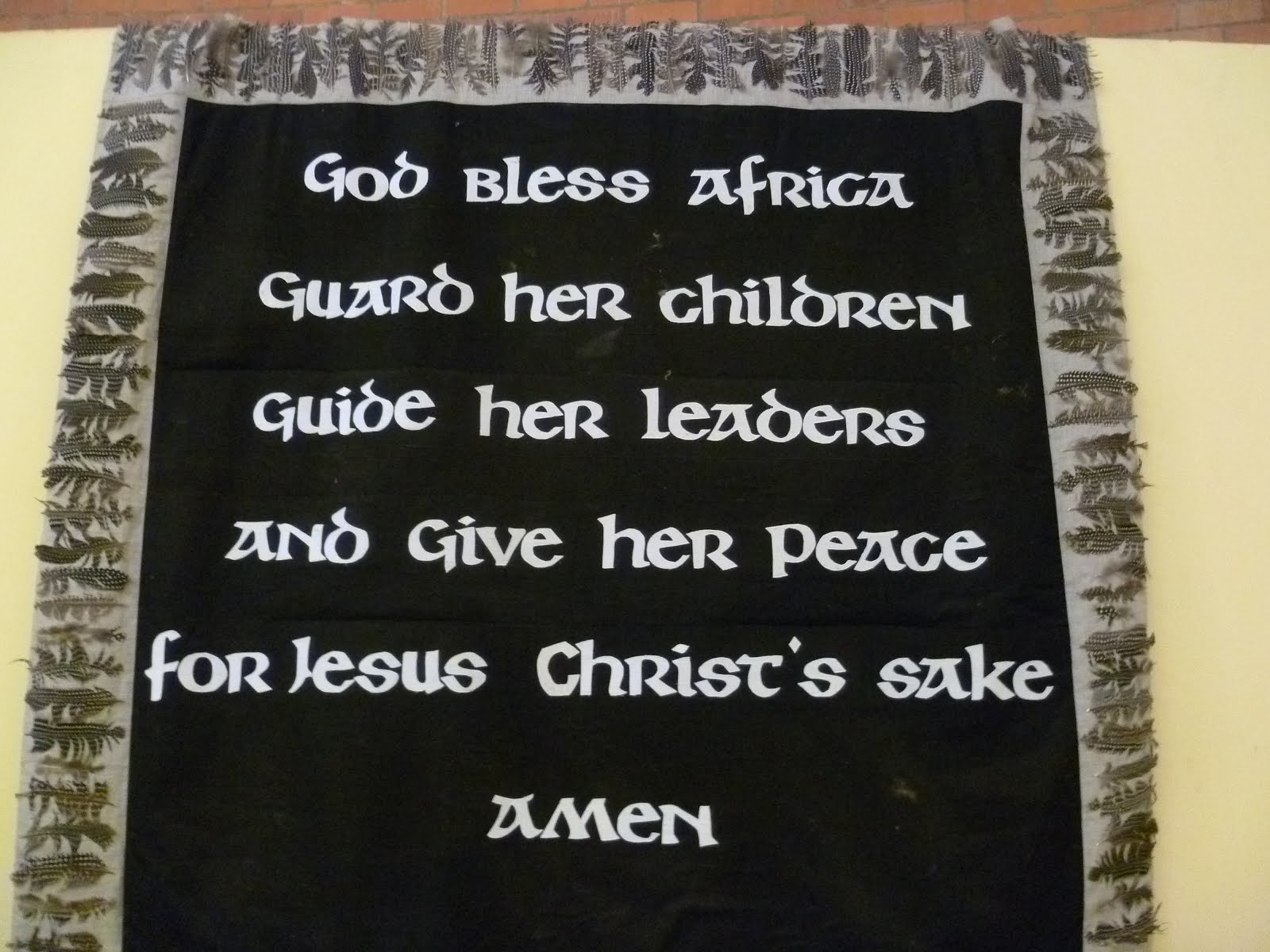
Prayer for Afrika, by Bishop Trevor Huddleston, Community of the Resurrection, a famous Anglican priest in Sophiatown, who fought against apartheid in the 1950s.